
LVP vs Laminate Flooring: 2026 Cost and Durability Guide
You are standing in a flooring aisle, staring at two planks that appear identical, but one costs twice as much. The packaging may use similar water-performance language even though the products have different cores, exposure limits, and installation requirements.
Waterproof and water-resistant labels can cover different test methods and exposure limits. Compare the exact manufacturer’s specifications, seam requirements, installation instructions, and warranty terms rather than assuming the labels mean the same thing.
The better choice depends on room conditions, water exposure, scratch risk, comfort, appearance, maintenance, and installation. This guide compares those trade-offs so you can choose a product that fits the room rather than relying on a single marketing claim.
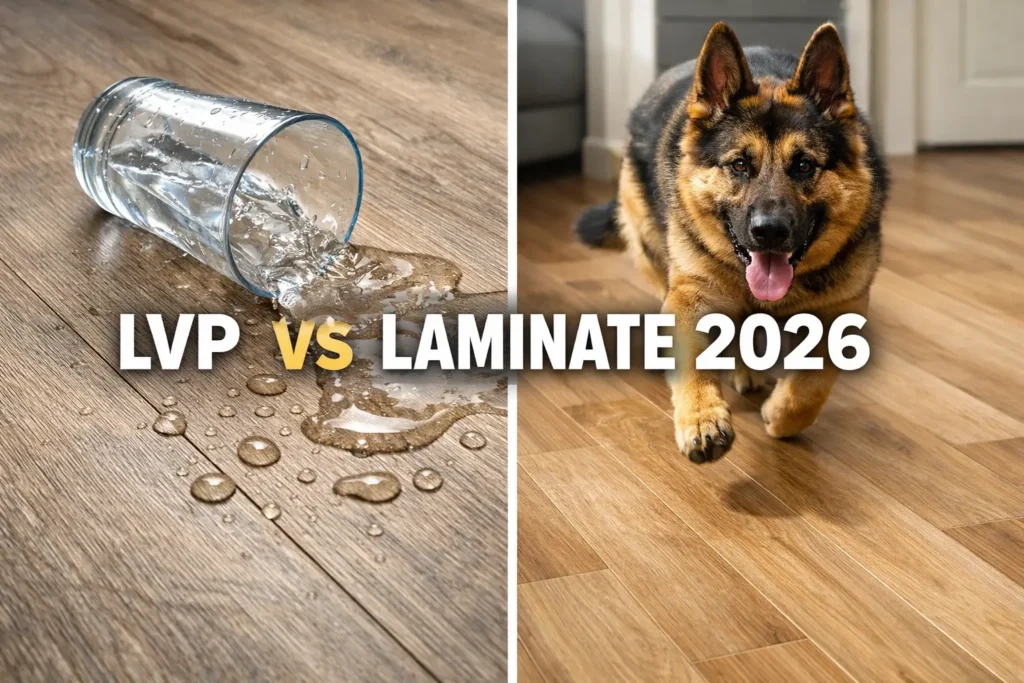
Table of Contents
LVP vs Laminate Flooring: Quick 2026 Answer
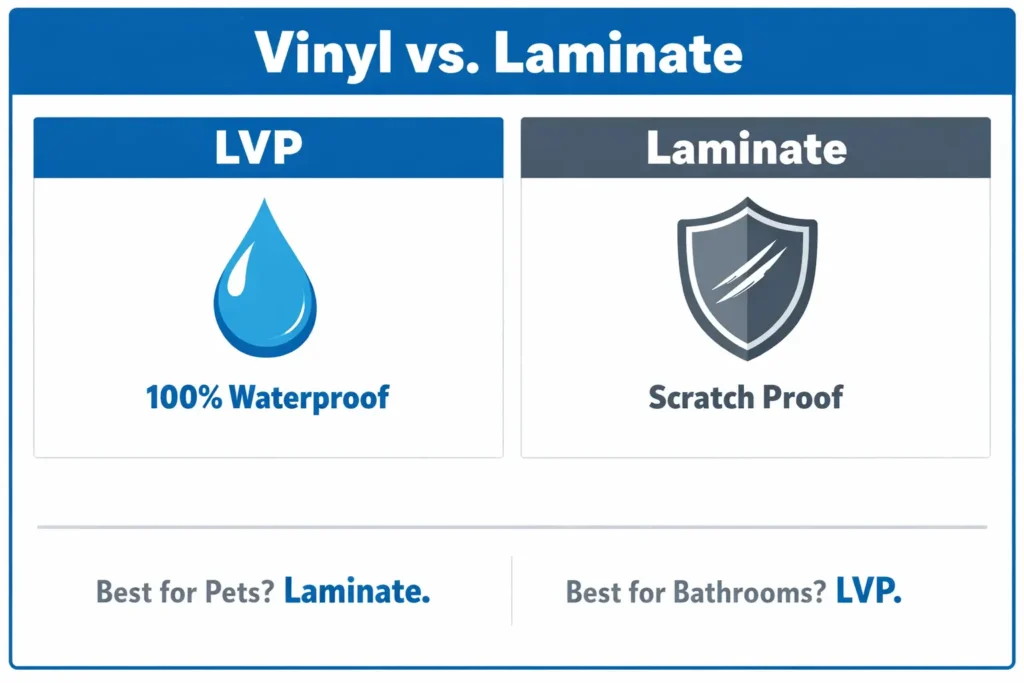
In 2026, choose LVP if water resistance matters most. It is the safer choice for basements, bathrooms, kitchens, laundry rooms, and homes with potty-training pets. Choose laminate if scratch resistance and a more realistic hardwood look matter more than flood protection.
The simple rule is this: LVP beats laminate for water, while laminate beats LVP for scratches and wood realism. The better floor depends on your room, pets, subfloor, and how much water risk you are willing to accept.
Which Is Better: LVP or Laminate?
| Your Priority | Better Choice | Why |
|---|---|---|
| Waterproof protection | LVP | The plank itself will not swell like wood-fiber laminate. |
| Large dogs and claw scratches | Laminate | AC4 and AC5 laminate usually handles scratching better than soft vinyl wear layers. |
| Bathrooms, laundry rooms, basements | LVP | Better moisture tolerance makes it safer in rooms where leaks are more likely. |
| Most realistic hardwood look | Laminate | Premium laminate usually has deeper texture and better wood-grain detail. |
| Clean DIY install | LVP | You can score and snap many planks without sawdust or loud cutting. |
For homes with pets, compare this guide with our best flooring for pets guide. If you are comparing LVP against tile instead, read our tile vs vinyl flooring guide.
Water Performance: Product Claims and Core Differences
The term “waterproof” should be read together with the manufacturer’s stated test conditions, exposure limits, installation requirements, and exclusions. According to the National Association of Home Builders (NAHB), water damage is a leading cause of flooring failure.
Laminate is made of wood fibers at its core (HDF). Laminate typically uses a wood-fiber core, while water-protection systems and published exposure limits vary by product. Check the exact manufacturer’s water-resistance instructions because prolonged or hidden leaks can damage the floor or surrounding assembly.
LVP (Luxury Vinyl Plank) is synthetic. It is usually made of SPC (Stone Plastic Composite) or WPC (Wood Plastic Composite). Many SPC cores have strong resistance to swelling from water, but the performance of the installed floor also depends on joints, perimeter details, substrate, and product-specific guidance.
Scratch Resistance: Laminate and LVP Trade-Offs
If you have a 70lb dog or kids who treat the hallway like a racetrack, you need a hard surface. Some laminate products offer strong scratch resistance because of their wear surface, but performance varies by rating, finish, traffic, and product quality. It uses a top layer of aluminum oxide, one of the hardest minerals on earth. In 2026, you should look for an AC4 or AC5 rating.
LVP is softer. Even the commercial-grade material with a 20-mil wear layer can still scuff. Dragging heavy furniture without protection can scuff or damage LVP, with the severity depending on the wear surface, finish, load, and movement.
Lived-in Detail: Pet claws can create visible wear on either material over time. Scratch visibility depends on the product’s finish, wear surface, pet size, traffic, cleaning, and lighting.
Comparison Table: 2026 Performance Specs
| Feature | Luxury Vinyl Plank (LVP) | Laminate Flooring |
|---|---|---|
| Material Core | Synthetic (Stone/Plastic) | Organic (Wood Fiber) |
| Water Status | Product-dependent water resistance | Check product-specific exposure limits |
| Scratch Rating | Good (Depends on Mils) | Best (AC4/AC5 Rated) |
| Best For Pets | Small dogs / Potty training | Large dogs (Heavy claws) |
| Cut Method | Score & Snap (Quiet) | Saw (Noisy/Dusty) |
| Average Cost | $3.50 – $7.50 /sq ft | $1.50 – $5.00 /sq ft |
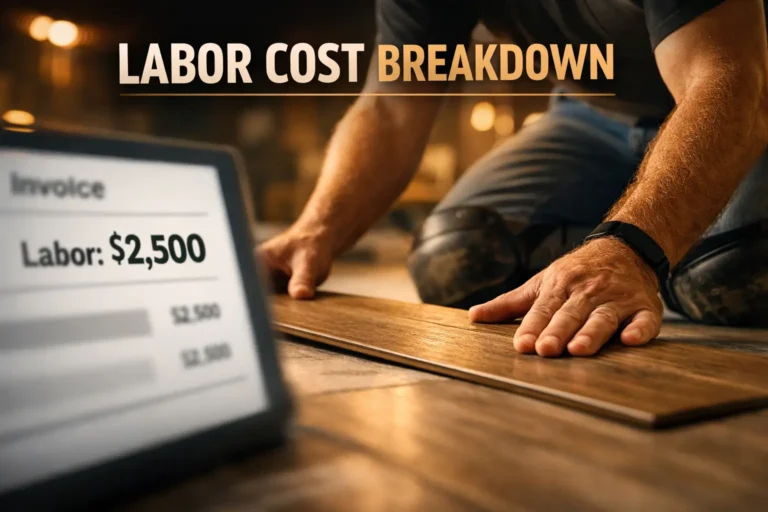
Cost note: The table above helps compare material-level pricing, but your installed price will also include labor, subfloor prep, trims, transitions, and waste. For full installed pricing, see our average flooring installation cost guide. For labor-only numbers, use our flooring labor cost per sq ft guide.
Avoiding the “Plastic Clack”
One of the biggest complaints about fake wood is the sound. Laminate is thick and rigid. If you use a cheap underlayment, walking on it sounds like clack-clack-clack. It feels hollow. LVP is denser. Because it is usually thinner and glued or clipped closer to the subfloor, it produces a duller thud.
The Tip: In 2026, many LVP planks come with Integrated Underlayment. This means the foam is already on the bottom of the plank. It saves you money and reduces noise for the people in the room below.
2026 Style Trends: The End of Cool Gray
Warmer wood tones are prominent in many current flooring collections, while gray and cooler finishes remain available for homeowners who prefer them. The big trend this year is EIR (Embossed in Register) texture. This is where the bumps and grooves you feel match the wood grain you see. It makes the floor look incredibly real.
Laminate actually does this better than LVP. Because laminate is thicker, manufacturers can press deeper textures into it. If you want a floor that looks like $15.00-per-foot White Oak (see our Hardwood Guide), a high-end laminate can provide a convincing wood look, depending on the print, texture, plank variation, and room lighting.
Best Laminate vs Luxury Vinyl Plank for a Hardwood Look
If your main goal is the most realistic hardwood look, premium laminate usually beats LVP. Laminate can hold deeper embossed-in-register texture, sharper grain detail, and a more convincing matte wood finish. LVP is better for waterproof performance, but many vinyl planks still repeat the same printed knots too often in large rooms.
Choose laminate for dry living rooms, bedrooms, and hallways where appearance and scratch resistance matter most. Choose LVP where water risk is higher, even if the wood look is slightly less realistic.
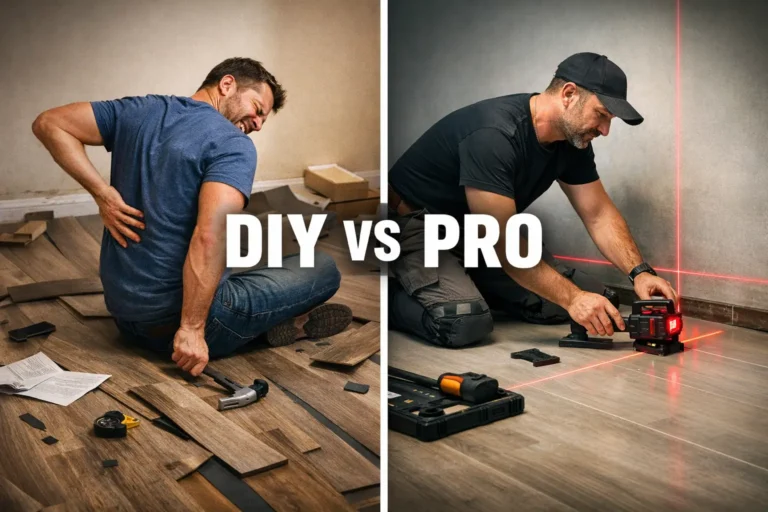
Installation Friction: What the Pros Don’t Tell You
Both floors are labeled DIY Friendly, but only the LVP is truly clean.
- LVP (Clean): You can cut LVP with a utility knife. You just score it and snap it like a piece of chocolate. There is no dust or noise.
- Laminate (Messy): Requires a saw. This creates a massive cloud of fine wood dust that will cover every piece of furniture in your house.
The Subfloor Trap: Concrete vs. Wood
Where you live matters more than the floor you pick. For more on this, check Consumer Reports.
You must use a moisture barrier, even if the floor says it’s waterproof. Concrete breathes moisture, which can cause the bottom of a laminate floor to rot within a year.
You may have a plywood subfloor. If you install LVP in a bathroom and it leaks, the plywood underneath will rot, and you won’t notice it until the floor feels mushy.
FAQs
What is the difference between laminate and LVP?
The biggest difference is the core. Laminate uses a wood-fiber core, so it is usually better for scratch resistance and hardwood realism, but weaker against water. LVP uses a vinyl or SPC/WPC core, so it handles moisture better but can scuff more easily.
Which is better in 2026, LVP or laminate?
LVP is better for kitchens, bathrooms, basements, laundry rooms, and leak-prone homes. Laminate is better for dry rooms where you want stronger scratch resistance, better wood texture, and a more realistic hardwood look.
Can I use a steam mop on LVP?
No. Never use steam on LVP or Laminate. The heat can melt the glue or force moisture into the core. Use a damp microfiber mop and a pH-neutral cleaner.
Which is better for resale value?
In 2026, LVP is slightly more appealing for resale in starter homes because people value the word “waterproof.” In higher-end homes, people prefer the more realistic look of premium laminate.
How do I tell a good LVP from a bad one?
Check the Wear Layer. Do not buy anything under 12 mil. For a home with dogs, you want 20 mil. Anything less will look like a scratched mess within two years.
Why does my laminate floor have a gap?
This usually means you didn’t leave an Expansion Gap at the walls. When humidity changes, the floor tends to shift. If it hits the wall, it will buckle or pop its joints. (Check Measurement Guide).
Is SPC better than WPC?
SPC (Stone Plastic) is harder and better at resisting dents from heavy furniture. WPC (Wood Plastic) is softer and warmer underfoot. For most families, SPC is the safer 2026 bet.
Conclusion
There is no better floor than the one that fits your life. Choose LVP if you are flooring a basement, a bathroom, or a kitchen. It is the only material that gives you total peace of mind against spills.
Choose Laminate if you want the most beautiful wood look and have big dogs with heavy claws. Just be sure to wipe up any major spills within a few hours to protect the joints.
Ready to start picking your colors?

One Comment