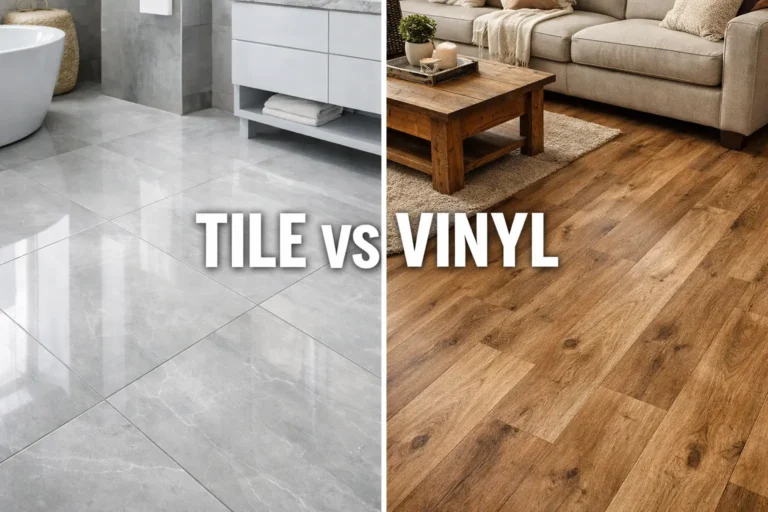
How to Estimate Flooring Costs: 2026 Price & Labor Guide
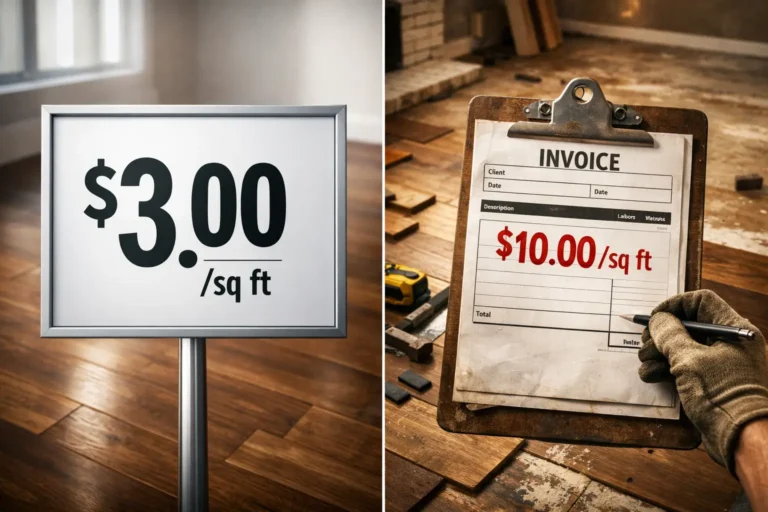
Most homeowners walk into a showroom, see a beautiful plank for $3.50 per square foot, and assume their 500-square-foot room will cost $1,750. That is rarely true. By the time you factor in removing your old carpet, leveling your bumpy subfloor, and the service fees that have become standard in 2026, the $1,750 quickly jumps to $4,000 or more.
This guide helps you find your actual “Out-The-Door” number. We’ll review the current 2026 rates and the hidden friction points that contractors often wait to mention until your old floor is already torn up and you’re stuck.
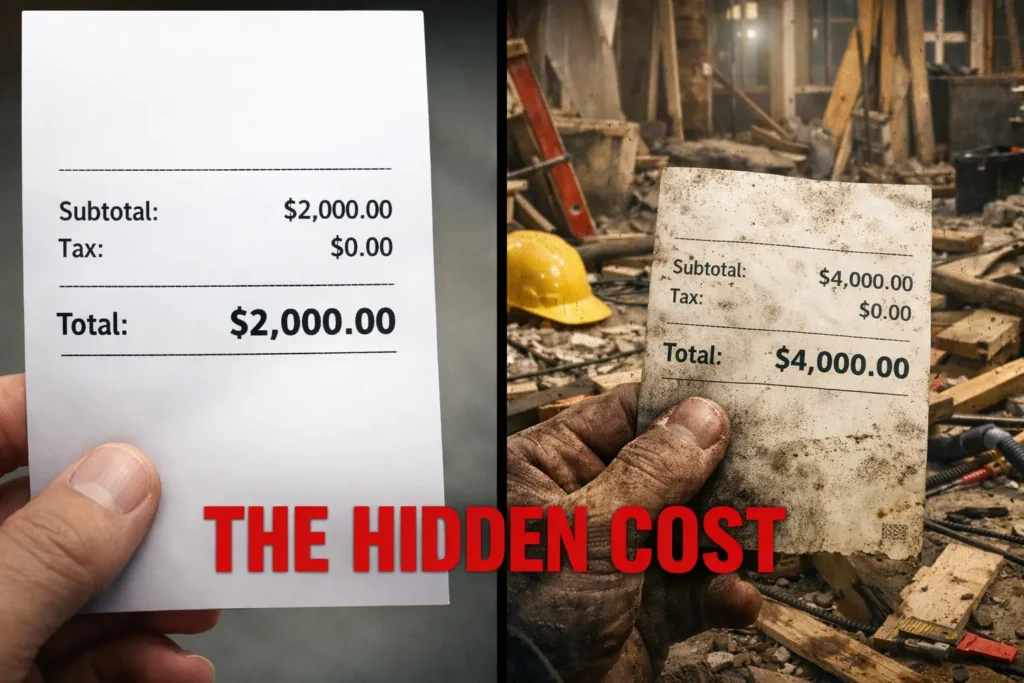
Table of Contents
Why the Sign Price is a Lie
In 2026, labor rates have split into two categories: the Big Box flat rate and the Private Pro rate. While a store might advertise a cheap installation price, they often hide the complexity of your home in the fine print. According to BLS data, labor costs are rising due to a shortage of skilled tradespeople.
| Labor Task | 2026 Price Range | The Real-World Friction |
|---|---|---|
| Basic Installation | $1.50-$4.50 /sq ft | Only applies to a spotless, empty room. |
| Subfloor Leveling | $50-$90 /per bag | If your floor waves, you might need 10+ bags. |
| Stair Installation | $15-$150 /per step | Hardwood is high-end; LVP is cheaper. |
| Minimum Trip Fee | $350-$700 | Doing a tiny bathroom? You’ll still pay this. |
Many installers now charge a Fuel Surcharge or a Parking Fee if you live in a dense city such as London, New York, or Sydney. Always ask if their quote includes “travel and tolls” before you sign.
Getting Rid of the Old Stuff
Ripping up your old floor is a dirty, heavy job. If you pay a pro to do it, you aren’t just paying for their time; you’re paying for the dump fees.
$1.00-$2.00 per sq ft. It’s easy to rip up, but it’s bulky and takes up a lot of room in a trailer.
$3.00-$5.00 per sq ft. This is back-breaking work and requires scraping the subfloor.
$5.00-$9.00 per sq ft. This is the Budget Killer. It generates large amounts of dust and heavy debris.
But wait: In 2026, many regional councils have new Heavy Waste recycling laws (check EPA guidelines). Ask your contractor if the removal fee includes the dump fee. If it doesn’t, you might find a pile of old tile left on your driveway with a note reading “Customer to Arrange Disposal”.
Subfloor Prep: The Invisible Cost
You can’t put a new floor on a bad foundation. In 2026, thinner click-lock floors like those found in our Vinyl Calculator are very popular, but they require a subfloor that is flat within 3/16 inch.
If your floor has a dip or a hump, the installer will have to use Self-Leveling Underlayment (SLU). This is a liquid cement that is poured to level the floor.
- The Cost: $45–$75 per bag for materials plus $60 per hour for labor.
- The Trap: A contractor might quote you for two bags but end up using ten. This “Subfloor Surprise” can add $700 to your bill.
Regional Pricing: USA, UK, Canada, and Australia
Prices vary by where you live, but the 2026 averages stay within these ranges for a 500 sq ft (46 m²) room:
USA & Canada
- Budget (Laminate/Vinyl): $2,500-$4,500
- Mid-Range (Engineered Wood): $5,000-$8,500 (See Hardwood Calculator)
- High-End (Hardwood/Tile): $9,000-$15,000+
UK & Australia
- Budget (LVT/Laminate): £1,800-£3,200 / $3,500-$6,000 AUD
- Mid-Range (Timber/Hybrid): £4,000-£6,500 / $8,000-$12,000 AUD
- High-End (Stone/Hardwood): £8,000+ / $15,000+ AUD
The Extra Parts People Forget to Budget
People focus on the plank price and forget the trim price. These parts are necessary to complete the floor.
- Transition Strips: $50-$95 per strip. You need one for every door. If you have five doors, that’s $450.
- Quarter-Round / Beading: $2.00-$4.00 per linear foot. This hides the gap in the wall.
- Moisture Barrier (Concrete): $1.00 per sq ft. Do not skip this in the UK or Australia; concrete retains moisture that can cause your floor to rot.
FAQs
Can I save money by buying the flooring myself?
Yes. Contractors often add a 10–20% markup on materials. Buying the boxes yourself can save you hundreds, but make sure you order the correct quantity using our measurement guide.
Why did my quote include a Furniture Fee?
Installers aren’t movers. If they have to touch your sofa, fridge, or bed, they charge $150–$400 per room. Save money by moving everything yourself before they arrive.
What is a Site Visit Fee?
In 2026, many high-quality pros charge $75-$100 to come out and give you an estimate. They usually subtract this from your final bill if you hire them. This filters out people who aren’t serious.
Is tile significantly more expensive to install?
Yes. As shown in our Tile Cost Calculator, tile requires three separate trips: one to lay the tile, one to grout, and one to seal. You are paying for the installer’s gas and time for those extra days.
Should I pay for Acclimation time?
You don’t pay for time; you pay for delivery. Wood and LVP need to acclimate to your home’s temperature for 48–72 hours. Some stores charge a double delivery fee when they must drop off the wood early.
Final Check: Before You Hand Over the Deposit
- Check the Dye-Lot: Ensure all boxes were made in the same batch so the colors match.
- Haul-Away: Confirm that removal includes taking the old floor to the dump.
- Payment Terms: Never pay more than 30% upfront. In 2026, a contractor requesting 50% or more is a major red flag.
- Written Guarantee: Get a 1-year artistry warranty in writing. If a plank pops up in six months, you shouldn’t have to pay them to come back.
Conclusion
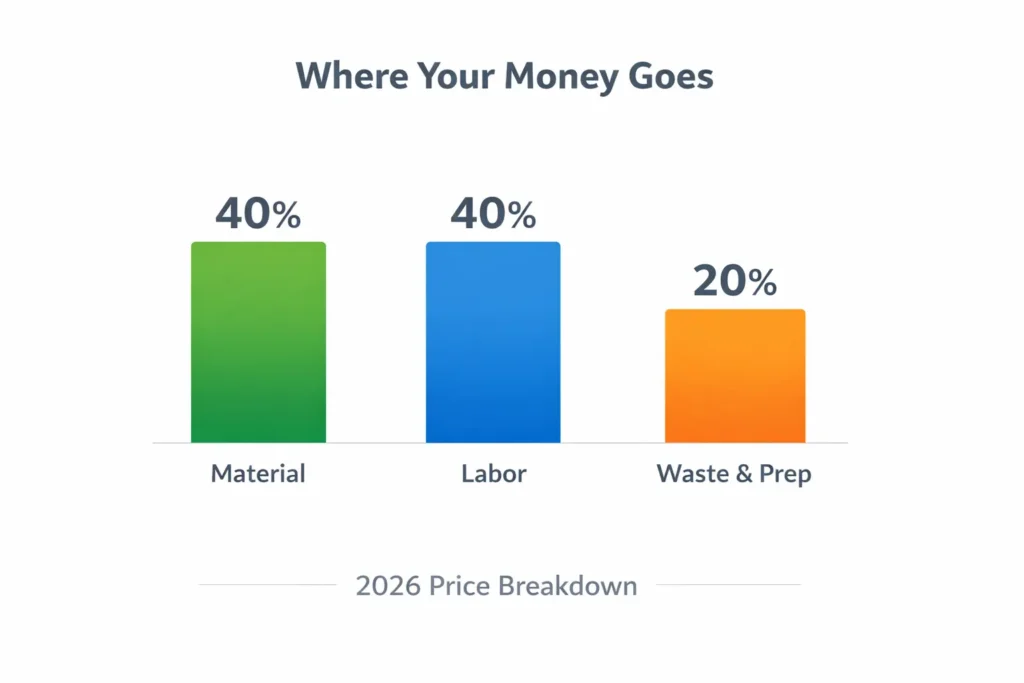
Estimation is about protecting yourself from the Hidden Middle. The material is the easy part; the prep and the parts are what drive costs. Take your time, get three quotes, and always keep a 20% contingency fund for the surprises waiting under your old carpet.
Ready to start picking your materials? Use our calculators to find the best floor for your budget.