
Flooring Labor Cost Per Sq Ft: 2026 Installation Price Guide
When you see a labor quote of $4.00 per square foot, it’s easy to think you are just paying someone to click planks together. In 2026, professional labor is about risk management. You aren’t just paying for the laying of the floor; you are paying for specialized tools, years of experience, and insurance that protects your home if something goes wrong.
This guide dives into the various phases of a labor quote so you can see where your money goes and why cheap labor often turns into an expensive nightmare. For a broader look at material prices, check our Flooring Cost Factors Guide.
Table of Contents
Flooring Labor Cost Per Sq Ft in 2026
In 2026, flooring labor usually ranges from $2.00 to $17.00+ per square foot, depending on the material, layout, and job complexity. Click-lock floors like laminate and vinyl sit at the low end, while hardwood and tile labor run higher because prep, cutting, and finishing take more time and skill.
If you are searching for the average cost of flooring installation per square foot in 2026, this page focuses on labor only. For full installed pricing that includes materials, trim, underlayment, and removal, see our average flooring installation cost guide.
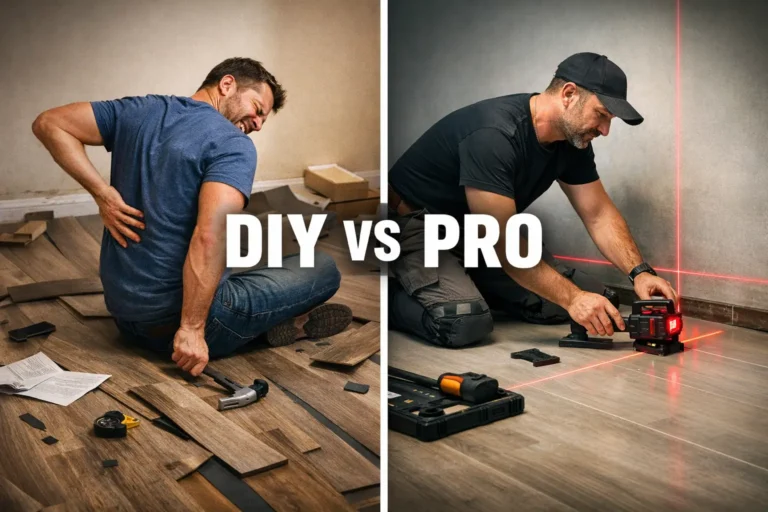
Labor is only one part of the final quote. To see where surprise charges come from, read our hidden flooring costs guide and our DIY vs professional flooring cost comparison.
A professional quote is usually broken down into these three parts. If your contractor gives you one flat number, ask for a breakdown.
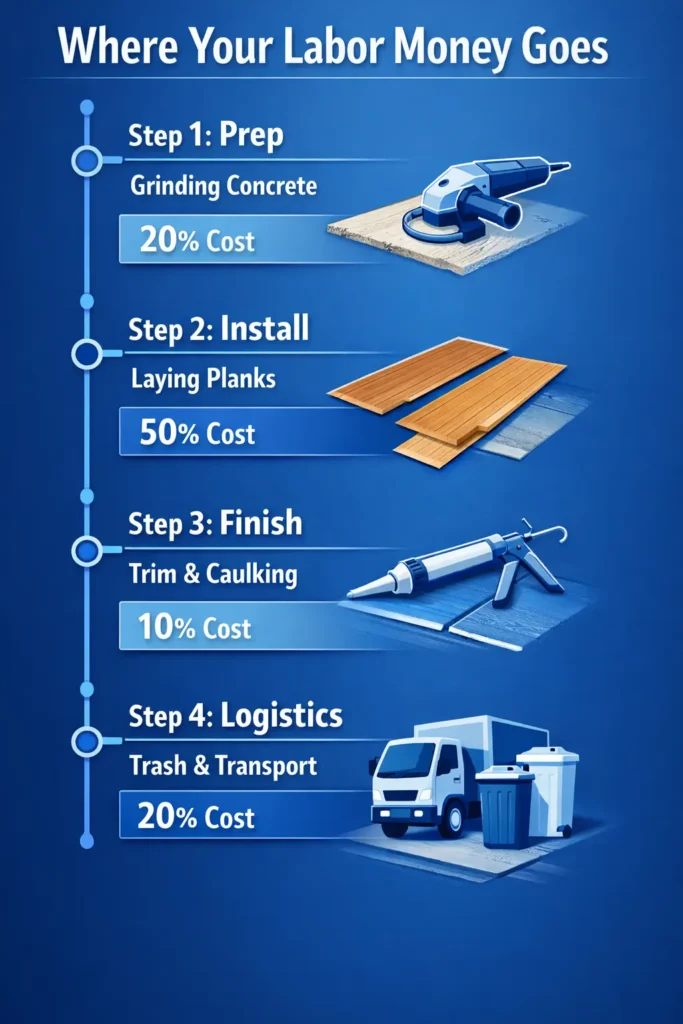
Phase 1: Subfloor Prep (The Foundation)
This is the hardest physical work. It involves grinding down concrete humps, filling in dips with a leveler, and ensuring the surface is dry and clean.
- Labor Cost: $1.00-$3.50 per sq ft.
- The 2026 Reality: Pros now use digital moisture meters. If they find moisture, they will require a moisture barrier to protect your warranty.
Phase 2: The Lay (The Visible Work)
This is the actual installation. The cost varies by material difficulty:
- LVP / Laminate: $2.50-$5.00 per sq ft.
- Engineered / Solid Wood: $5.00-$12.00 per sq ft.
- Tile: $8.00-$18.00 per sq ft (requires multiple trips for mortar and grout).
Phase 3: Finishing (The Precision)
This includes installing transition strips and scribing, the art of cutting a floor to fit perfectly against a stone fireplace or curved wall.
- Labor Cost: $1.00-$2.50 per linear foot.
2026 Labor Rates by Material (Labor Only)
According to construction data from the Bureau of Labor Statistics, specialized trade rates are outpacing general labor.
| Material Type | Basic Labor (per sq ft) | Complex Labor (Stairs/Patterns) |
|---|---|---|
| Luxury Vinyl (LVP/SPC) | $2.50 – $4.50 | $5.50 – $8.00 |
| Laminate | $2.00 – $5.00 | $6.00 – $9.00 |
| Engineered Wood | $4.50 – $8.00 | $9.00 – $14.00 |
| Solid Hardwood | $7.00 – $12.00 | $16.00+ |
| Ceramic/Porcelain Tile | $9.00 – $17.00 | $22.00 – $38.00 |
Labor Cost to Install Hardwood Floors Per Square Foot
Hardwood labor usually costs more than vinyl or laminate because there is less room for error. Moisture testing, layout, fastening, and finishing details all add time to the job.
- Engineered hardwood labor: $4.50 to $8.00 per square foot for straightforward rooms.
- Solid hardwood labor: $7.00 to $12.00 per square foot for standard installations.
- Complex hardwood labor: $16.00+ per square foot for stairs, borders, and patterned layouts.
For the full project picture, including material pricing, see our hardwood flooring cost guide.
Real Experiences: The Inside Details
The Square Foot price is only half the story. Homeowners in 2026 are reporting these logistical headaches that drive up the final bill:
Most flooring installers are not plumbers. If you are flooring a bathroom, you’ll pay $150-$300 just to pull and reset a toilet. If the pipe below is at the wrong height for your new thick floor, you’ll need a licensed plumber, which will incur an additional $400 service call.
- 🪜 The Vertical Tax (Stairs): In 2026, installers charge $100 to $250 per step. A single flight of stairs can add $2,500 to your labor bill because each step requires precision nosing and safety gluing.
- 🗑️ The Disposal Disconnect: Ripping out old carpet is one thing; getting it off your property is another. Many quotes for Removal don’t include Haul Away. You might find a giant pile of trash on your driveway unless you pay the $200-$400 dump fee.
The Access Factor: Logistics That Drive Up Quotes
In 2026, labor isn’t just about the work on the floor; it’s about the effort to get to it. Contractors are increasingly adding Logistics Fees based on your home’s layout.
- High-Rise & Apartment Surcharges: If your installer must use an elevator or carry boxes up three flights of stairs, a 15% Access Fee applies. Carrying 50 boxes of 40lb vinyl is a labor-intensive task.
- Parking and Permits: In cities like London, NYC, or Toronto, parking a work van can cost $60-$100 a day. Professional contractors build this into the Labor line item.
- The Occupied Home Premium: It is significantly harder to install flooring in a home with children, pets, and furniture. If the crew must move living items daily, the labor rate will be higher. Check our Pet Flooring Guide for durability tips.
The Insurance Gap: Why Cheap is Dangerous
It is tempting to hire a handyman for $1.50 a foot. In 2026, this is the leading cause of flooring failure.
If a cheap installer nicks a water line and floods your kitchen, and they don’t have General Liability Insurance, you are responsible for the damages. A professional contractor’s rate includes this protection.
Manufacturers are strict. If a handyman skips the moisture test and your floor buckles, the manufacturer will deny your claim. You’ll end up paying for the material and labor twice.
FAQs
What is the difference between a Labor Warranty and a Product Warranty?
The product warranty (from the store) covers fading. A Labor Warranty (from the installer) covers gapping or lifting. In 2026, a pro should offer at least a 1-year workmanship guarantee.
How do I check a contractor’s insurance?
Ask for their Certificate of Insurance (COI). A real pro will have it emailed to you in minutes. If they make excuses, do not let them into your house.
Do I pay more for Closets and Nooks?
Yes. Small spaces require twice as long to install due to additional cutting. Many pros charge a flat fee of $50–$100 for the extra time spent in tight spaces. (See Carpet Guide for closet measuring tips).
What if they find mold during removal?
Work will stop immediately. Mold remediation in 2026 costs $10- $25 per square foot. According to EPA Mold Guidelines, never cover it up; the rot will eventually destroy your new floor and your health.
What is the average cost of flooring installation per square foot in 2026?
This page covers labor only. Based on the material ranges in this guide, labor alone commonly runs from about $2.00 to $17.00+ per square foot. Your full installed cost will be higher once you add materials, underlayment, trim, demolition, and disposal.
What is the labor cost to install hardwood floors per square foot?
In 2026, engineered hardwood labor usually falls around $4.50 to $8.00 per square foot, while solid hardwood labor is often $7.00 to $12.00 per square foot. Stairs, borders, and patterned installs can push hardwood labor to $16.00+ per square foot.
Conclusion
When comparing quotes, look for the person who addresses subfloor preparation. The installer who says, “I can just lay it right over the old floor,” is the one who will cost you the most in the long run. The professional who brings a level and checks for moisture is the one who will save you thousands in the next decade.
Ready to see where it’s safe to save? Check out our Cheap vs. Expensive Flooring Comparison.

One Comment