Average Flooring Installation Cost Per Sq Ft in 2026
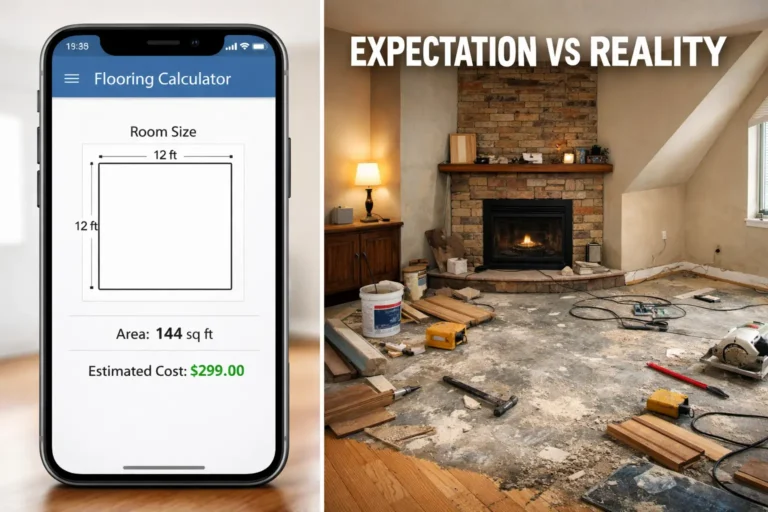
Most homeowners start their projects by considering material costs. They see a beautiful floor priced at $3.00 per square foot and think they are ready to proceed. Then the contractor hands them a quote, and that $3.00 suddenly balloons to $10.00 or even $15.00 per square foot.
In 2026, the price depends more on the condition of your subfloor and your local labor market than on the actual planks you pick. If you live in a city where gas and insurance have spiked, your average will look much higher than a rural estimate.
This guide breaks down the real-world numbers you’ll see on a quote today. We are looking at the total cost, materials plus labor, so you can walk into a flooring store with your eyes wide open. For a deeper dive into hidden fees, check our Flooring Cost Factors Guide.
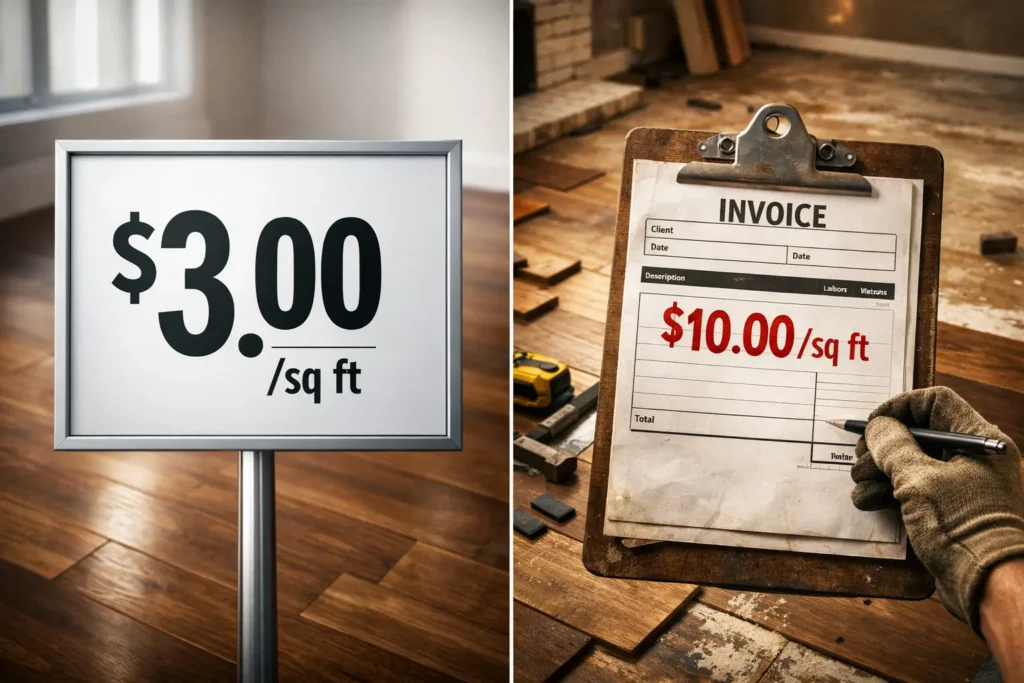
Table of Contents
Average Flooring Installation Cost Per Square Foot in 2026
In 2026, the average cost to install flooring per square foot usually lands between about $4.00 and $28.00 installed, depending on the material, labor market, subfloor condition, and how much prep the job needs. Lower-cost laminate and vinyl projects sit near the bottom of that range, while hardwood and tile push the average much higher.
This page covers the full installed cost, meaning materials plus labor. If you want labor-only pricing, see our flooring labor cost per sq ft guide. If you want the extra charges that often get missed, read our hidden flooring costs guide.
The 2026 Cost Breakdown by Material
Material choice is your biggest lever for controlling the budget. However, remember that cheaper materials often have higher failure rates if the subfloor isn’t perfect.
| Flooring Material | Material Cost (per sq ft) | Labor Cost (per sq ft) | Total Average Installed |
|---|---|---|---|
| Laminate | $1.50 – $4.00 | $2.50 – $5.00 | $4.00 – $9.00 |
| Vinyl Plank (LVP) | $2.00 – $6.00 | $3.00 – $5.50 | $5.00 – $11.50 |
| Engineered Wood | $5.00 – $11.00 | $4.00 – $9.00 | $9.00 – $20.00 |
| Solid Hardwood | $7.00 – $15.00 | $6.00 – $12.00 | $13.00 – $27.00 |
| Ceramic/Porcelain Tile | $2.00 – $12.00 | $7.00 – $16.00 | $9.00 – $28.00 |
What the Average Looks Like in Real Projects
A basic laminate or LVP install usually lands near the low end of the average because the material is cheaper and the layout is simpler.
The average rises when you add furniture moving, trim work, transitions, and extra waste for longer sight lines.
These spaces usually sit above the average because moisture prep, cut-heavy layouts, and specialty labor push the installed price higher.
If you are comparing room sizes instead of materials, use our small room flooring cost guide and large room flooring cost guide.
What People Actually Experience
Data is one thing; the reality of a 2026 renovation is another. Here are the points that homeowners are reporting right now, backed by Consumer Reports.
If your project includes a staircase, ignore the square foot price. In 2026, installers are charging $100 to $200 per step for labor alone. Because each step requires complex nosing and precision cuts, a single flight of stairs can add $2,000 to your bill.
Supply chains remain unpredictable in 2026. People often experience order drift, where a product is marked as in stock but takes 8 weeks to arrive. Never rip up your old floor until the new boxes are physically in your garage.
A common experience during removal is damage to baseboards and drywall. Removing old ceramic tile requires a jackhammer. Vibration can crack paint or chip the bottoms of your door frames. Always budget an extra $300 for touch-up painting.
The Hidden Costs That Kill the Average
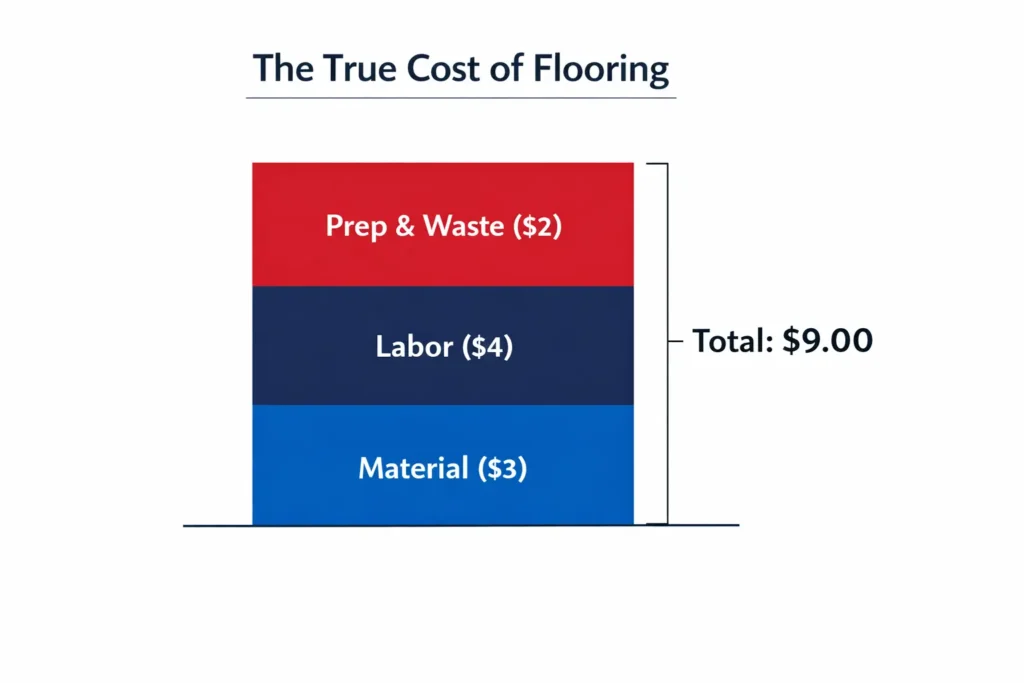
When you ask, “What is the average flooring installation cost per sq ft?”, most people forget to include the prep work. This is where 2026 budgets go to die.
- Subfloor Leveling: $55-$95 per bag of leveling compound. If your floor has waves, expect to add $1.00-$2.00 per sq ft for the liquid cement.
- Removal of Old Floor: $1.50-$3.50 per sq ft. Carpet is easy; tile is a nightmare that requires heavy labor and a dump trailer. (See Carpet Removal Rates).
- The Furniture Surcharge: Many big-box stores offer Basic Install, but they won’t tell you that it doesn’t include moving your heavy stuff. If they need to move a piano, a fridge, or a pool table, an additional fee of $150-$400 applies.
Regional Pricing: Where You Live Matters
In the U.S., your local economy heavily influences the average in 2026. The comparison below starts with U.S. pricing, then shows UK, Canada, and Australia for context. For more detailed local cost data, sites like Angi track regional averages.
$9.00-$16.00 per sq ft
(Midwest averages are often 30% lower)
£40-£85 per m²
$12.00–$22.00 per sq ft (CAD/AUD)
In high-density cities like London, NYC, or Sydney, expect a 20% Logistics Premium. Contractors in these areas must manage parking permits and congestion charges, which are always passed on to you.
The Warranty: Your Subfloor is Your Insurance
Most homeowners assume a Lifetime Warranty protects them if their floor clicks, pops, or gaps. In 2026, this is a dangerous mistake. Manufacturers are now incredibly strict about installation conditions to avoid paying claims.
The Readiness Rule:
- Flatness: Dips and humps snap fragile plastic joints. The floor must be flat.
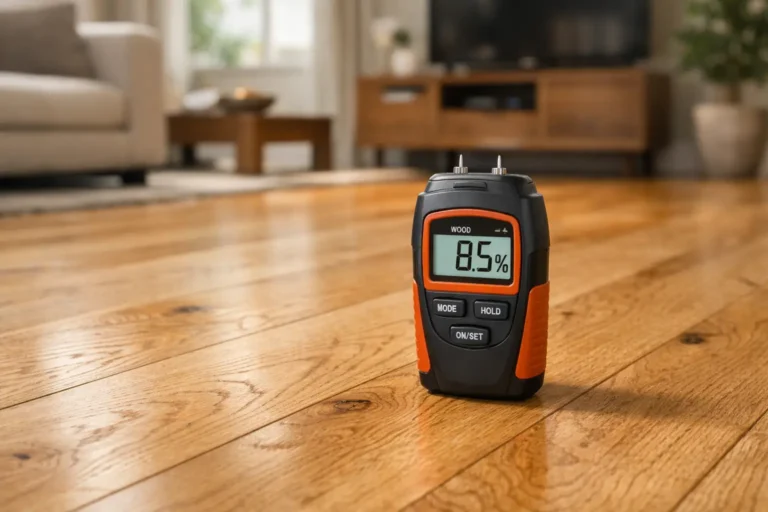
- Moisture: Concrete breathes. Without a moisture barrier, dampness will rot your floor from the bottom up.
- Debris: Even a tiny pebble left on the subfloor can cause a bump you’ll feel underfoot every day.
FAQs
Is it cheaper to buy the materials myself?
Yes. Contractors often add a 10% to 20% markup on materials. If you buy the boxes yourself and just hire the labor, you can save several hundred dollars.
Can I save money by removing it myself?
Absolutely. Ripping out old carpet and padding is the easiest way to save $1.50 per sq ft. Please remove all old staples and tack strips so the subfloor is clean for the pro.
What is a waste factor?
You must buy 10% more material than your actual square footage. You will lose planks to cuts and mistakes. If you have a complex pattern like Herringbone, that “waste” jumps to 20%. See our Waste Calculation Guide.
Why is hardwood installation so expensive?
It’s the skill involved. Solid hardwood has to be nailed or glued, sanded, and finished. It’s a craft that takes days, whereas LVP can be clicked together in a few hours.
Should I pay for a professional estimate?
In 2026, many top-tier installers charge a $75-$100 fee to measure your house. Don’t be offended; they usually credit this back to you if you hire them.
What is the average cost to install flooring per square foot in 2026?
For most 2026 projects, flooring installation usually ranges from about $4.00 to $28.00 per square foot installed. The final number depends on the flooring material, labor rate, removal, prep work, and whether the room includes stairs, transitions, or moisture issues.
What is the average cost for floor installation in a typical room?
A typical room sits closer to the middle of the range when you choose laminate or LVP and the subfloor is in good condition. Costs rise quickly in kitchens, bathrooms, staircases, and older homes where leveling, removal, or moisture barriers are needed.
Conclusion
Don’t let the average cost fool you into thinking every quote will be the same. The best way to get a fair price is to obtain three written quotes and ensure they all include the same scope: removal, preparation, and trim.
Ready to find out what you are actually paying for?