
10 Costly Flooring Measurement Mistakes & How to Avoid Them
Most people think a tape measure is just a tool. In reality, it is a high-stakes calculator. If you are off by even an inch, you don’t just lose an inch of floor; you lose days of work, hundreds of dollars in extra shipping fees, and your peace of mind.
In 2026, flooring is heavy, expensive, and hard to ship. If you run short by just three planks, you can’t just order a few more without paying massive delivery fees. This guide is your shield against the common math traps that ruin home projects.
If you haven’t calculated your total area yet, start with our guide on How to Calculate Square Footage before reading these mistakes.

Table of Contents
1. The Blueprint Trap
Why your house plans are often wrong
The biggest mistake you can make is ordering material based on architectural drawings or a real estate floor plan. Blueprints are perfect versions of a home. In the real world, walls shift, drywall adds thickness, and rooms are rarely perfectly square.
The Fix: Never buy flooring until you have physically walked the room with a tape measure. Measure the finished room, meaning after the drywall is up and the baseboards are ideally removed. For tips on hiring pros to verify measurements, check Consumer Reports on Contractors.
2. The Baseboard Blind Spot
Knowing exactly where to stop your tape
Most people pull their tape from one wall to the other. This is a gamble. If you are keeping your existing baseboards (skirting boards), you are not actually covering the whole space.
- The Problem: If you measure wall-to-wall but keep your thick baseboards on both sides, you are buying wood you don’t need. Conversely, if you pull baseboards to hide a gap, you must measure all the way to the studs.
- The Fix: Decide on your trim plan first. If the baseboards stay, measure to the wood. If they go, measure to the wall.
3. The Forgotten Closet
Don’t miss the rooms within rooms
It is easy to look at a bedroom as one big rectangle. People often forget that the floor continues behind the closet door.
The Problem: A standard closet adds about 10 to 15 square feet (1.4 square meters). If you have two closets in a main suite, you have just missed an entire box of flooring.
The Fix: Treat every closet like its own separate room. Measure the inside depth and width, then add it to your main room total.
4. The Doorway Gap
Why stopping at the door frame is a mistake
This is the technical error that leads to ugly gaps between rooms. Beginners often stop their measurement right at the edge of the wall where the door sits.
The Fix: Measure into the exact center of the doorway. This is where your Transition Strip (T-Molding) will sit. In a house with six doors, this invisible space adds up to a lot of material.
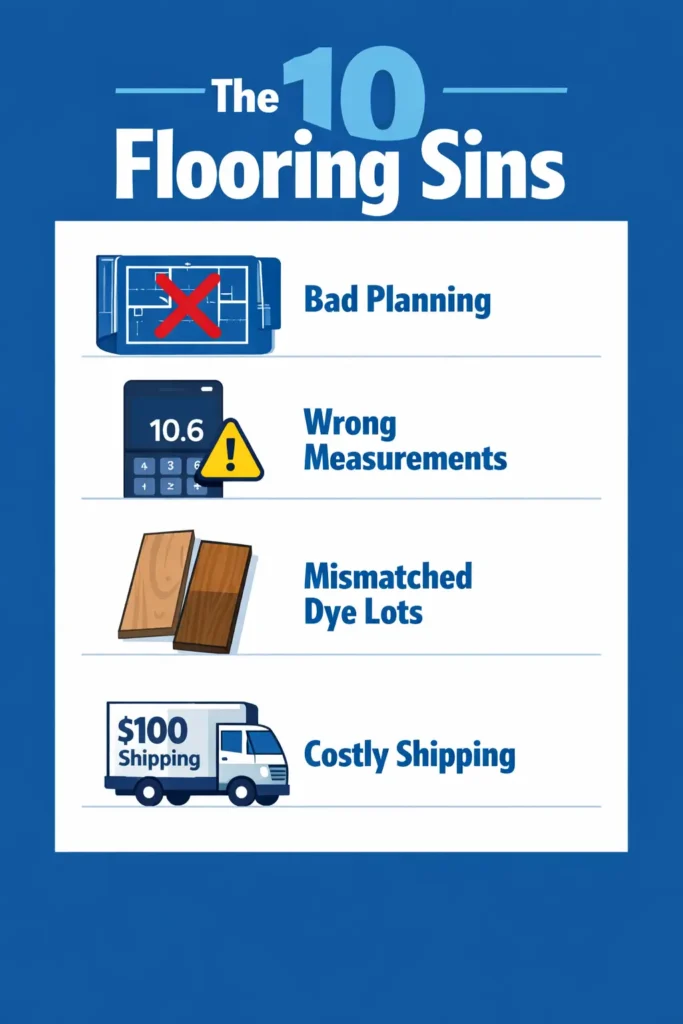
5. The “10.6” Math Error
Phone calculators vs. Tape measures
This is the most common reason people get their square footage wrong. Your phone calculator uses decimals, but your tape measure uses inches.
The Decimal Rule:
- 3 inches = .25 feet
- 6 inches = .50 feet
- 9 inches = .75 feet
Example: 10 feet 6 inches is 10.5, NOT 10.6.
6. The Tiny Strip Nightmare
Planning for the very last row
If your room is 120 inches wide and your planks are 7 inches wide, your last row will be a tiny 1-inch strip. These thin slivers are almost impossible to lock into place and often break within weeks.
The Fix: Divide your room width by the plank width. If the remainder is less than 3 inches, cut your first row of planks in half to balance the room. This is crucial for LVP installations.
7. Bumpy or Uneven Floors
Measuring flatness is just as important
In 2026, click-lock flooring featured thinner joints to reduce shipping costs. These joints break easily if the floor isn’t flat.
8. The Fancy Pattern Tax
When the standard 10% extra isn’t enough
If you saw a Herringbone or Chevron floor on social media and want to copy it, your standard math won’t work. Diagonal patterns require extensive cutting at the wall edges.
The Fix: For straight planks, use 10% extra for waste. For Herringbone or Chevron (common in Hardwood), you must use 20%.
9. The Dye-Lot Mystery
Why buying in small batches is a gamble
In 2026, supply chains move fast. If you buy 12 boxes now and 8 boxes next week, they may come from different batches. Batch A and Batch B might look the same in the store, but they will show a visible color difference once installed.
The Fix: Buy your entire order from the same pallet at once. Check the batch numbers before you leave the store.
10. Shipping Surcharges
The high cost of being wrong
Online flooring prices look great until you see the shipping tab. Ordering a large pallet might cost $200 to ship. But ordering one emergency box you forgot might cost $100.
For official shipping and logistics standards, you can refer to GSA Guidelines.
The Fix: Always round UP to the nearest full box. If your math says you need 12.1 boxes, buy 13. That extra half-box is your insurance.
Final Checklist: Did You Dodge the Mistakes?
- ✅ Closets: Included and measured separately?
- ✅ Doorways: Measured to the center of the threshold?
- ✅ Decimals: Used .5 for 6 inches (not .6)?
- ✅ Flatness: Checked the subfloor for dips or bumps?
- ✅ Dye-Lot: Verify that all boxes are from the same batch number.
Pro-Tip: Buy one extra box for Attic Stock. If you have a leak or a deep scratch, you will never find a matching plank again.
FAQs
How do I measure an irregular room with a bay window?
Treat the window area as a separate rectangle. Measure its widest and deepest points, then add them to your main room total.
Should I measure the floor area under my kitchen appliances?
Yes, for stoves and fridges so they stay level. No for heavy, fixed kitchen islands, as the weight can make floating floors buckle.
Do I really need to add 10% for waste if my room is a perfect square?
Yes. You will still have end-of-row cuts and the occasional damaged plank. It’s your safety net for a clean finish.
Can I use the square footage listed on my home appraisal?
No. Those numbers include wall thickness and un-floorable space. Always measure the actual floor surface yourself.
How do I measure for transition strips between rooms?
Measure the width of every doorway where the floor changes. Add them up and buy enough full strips to cover the total.
What is a Dye-Lot, and why does it matter?
A dye-lot is a specific batch. If you run short and buy more later, the shade might be slightly different, creating a visible line across your room.
Conclusion
Getting your flooring measurements right isn’t just about math; it is about protecting your bank account from hidden costs. In 2026, the biggest threat to your budget isn’t the price of the wood, it’s the cost of being wrong.
Measure twice, calculate once, and always buy that extra box.

One Comment