
How to Calculate Square Footage for Flooring: 2026 Guide
Calculating square footage (or square meters) seems simple on the surface: you multiply length by width, and you are done. However, in 2026, flooring materials will become more specialized. Click-lock joints are thinner, patterns are more complex, and supply chains are less forgiving.
If you are off by even half a box, you may face dye-lot inconsistencies where the new planks don’t quite match the old ones, or when expensive shipping delays occur. This is why using a precise measurement guide is critical.
This guide is designed to take you from a raw room measurement to a final, purchase-ready box count. We will cover basic math, hidden waste variables, and how to handle irregular architectural features that even experienced homeowners can trip up on.
Table of Contents
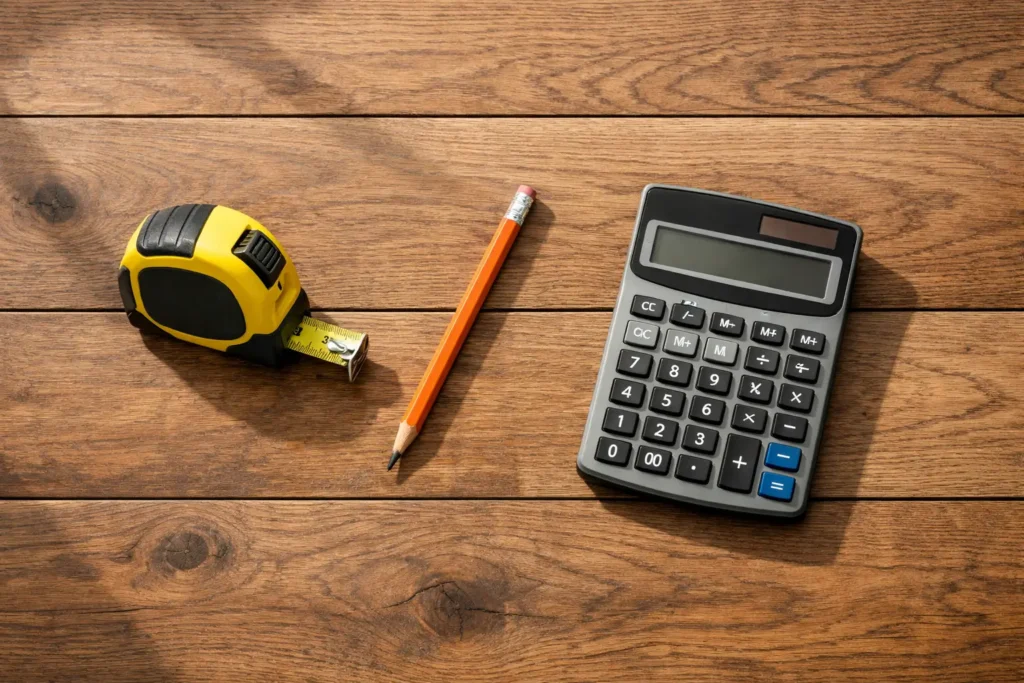
Which Tool Should You Use?
In 2026, the choice between analog and digital can be the difference between a 10-minute job and an hour of frustration.
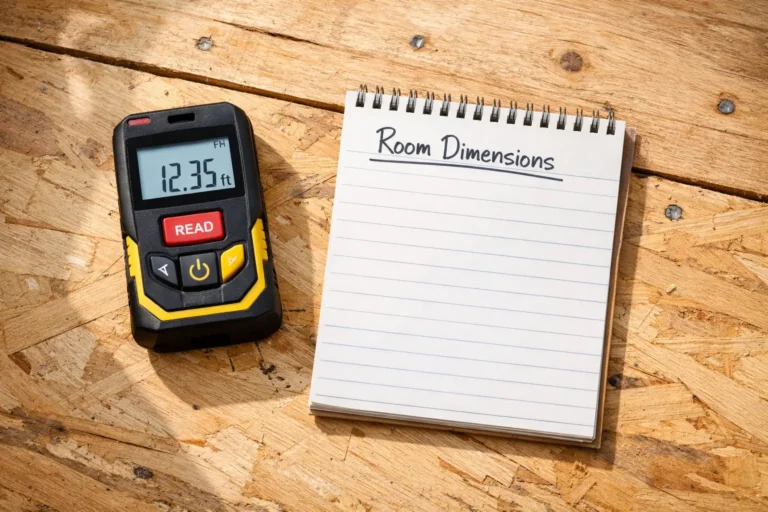
Note: Buy a laser measure if you are working alone. Keep a white sticky note to use as a target for the laser beam if it won’t settle.
The Foundation: Basic Area Formulas
Before we get into the complex what-ifs, we must establish the base area. In 2026, most global retailers still stick to two primary units of measurement. For precise standards, you can refer to the NIST Guide on SI Units.
Calculating in Square Feet (USA and Canada)
In North America, flooring is almost exclusively sold by the square foot (sq. ft.). While your tape measure shows feet and inches, your calculator only understands decimals.
The Conversion Table:
- 3 inches = 0.25 feet
- 6 inches = 0.50 feet
- 9 inches = 0.75 feet
- 1–2 inches = Round up to the nearest quarter-foot for safety.
The Master Formula:
Length (ft) x Width (ft) = Total Area
Example: A room that is 15′ 6″ long and 12′ 3″ wide becomes 15.5 x 12.25 = 189.88 sq. ft.
Calculating in Square Meters (UK, Australia, Europe)
For the rest of the world, the metric system simplifies things, but the logic remains identical.
The Master Formula: Length (m) x Width (m) = Total Area (m²)
Example: A room that is 4.5m long and 3.8m wide is 17.1 m².
The Divide and Conquer Method
Most modern homes are not perfect boxes. They have bump-outs, hallways, and alcoves. The biggest mistake you can make is trying to measure the average length and width of an irregular room. Instead, you must use the Sectional Method.
It doesn’t need to be pretty, but it must be accurate. Draw every nook and cranny.
Divide your sketch into as many perfect rectangles as possible. Label them Area A, Area B, etc.
Calculate the Area of each rectangle individually, then add them all together to get your Net Square Footage.
Your Net Square Footage is the amount of floor space physically visible. However, you cannot buy that exact amount. The following sections will explain why your Order Number is always significantly higher.
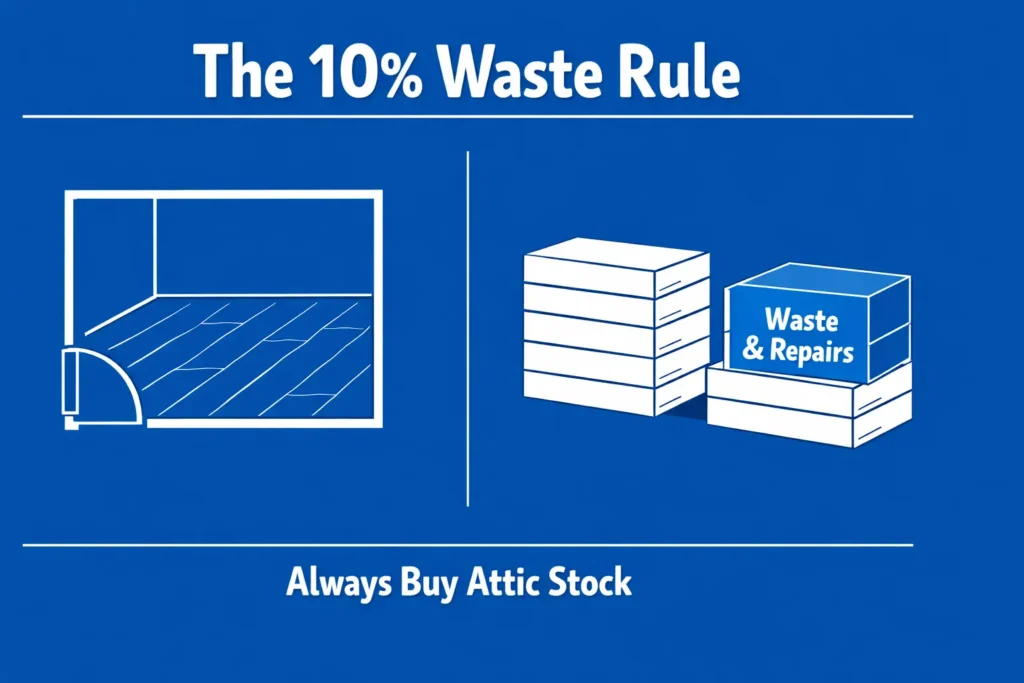
The Waste Factor: Your Insurance Policy
In the flooring industry, waste refers to the material that is cut off, damaged, or unusable. In 2026, with the rise of thinner LVP (Luxury Vinyl Plank) and more brittle laminate cores, the standard waste factor has become more critical than ever.
The Closet and Invisible Square Footage
One of the most common reasons DIYers run out of flooring is the Closet Trap.
Inside the Closet
Many homeowners assume a closet is part of the room and forget to measure the floor space behind the door. A standard 5-foot reach-in closet adds about 12 to 15 square feet. If you have two closets in a bedroom, you’ve just missed nearly a whole box of flooring.
Doorway Thresholds
When calculating, don’t stop at the wall. You must measure into the center of the doorway (under the door leaf). This is where your transition strip or T-molding will sit. In a house with six doorways, these 2-inch strips add up to significant square footage.
Under Appliances and Cabinets
- Kitchens: If you are installing a floating floor, do NOT calculate space under heavy cabinets. The weight will pin the floor down. Measure up to the toe-kick.
- Refrigerators/Stoves: Generally, you do want to floor under these, so they sit level with the rest of the kitchen.
Converting Area to Box Count: The Final Math
Retailers don’t care about your square footage; they care about how many boxes you’re taking. This is where the math often gets confusing.
The Box Calculation Formula
- Total Area + Waste = Total Needed.
- Total Needed / Carton Coverage = Raw Box Count.
- The Rounding Rule: You must ALWAYS round up to the next whole integer.
Real World Example:
- Room Size: 245 sq. ft.
- Waste (10%): 24.5 sq. ft.
- Total Needed: 269.5 sq. ft.
- Carton Size: 22.3 sq. ft.
- Math: 269.5 / 22.3 = 12.08 boxes.
- The Order: 13 Boxes.
How to Calculate Stairs: The Precision Zone
Stairs are the boss level of flooring math. You cannot calculate stairs using a simple length-by-width formula because specialized trim is required. (See our Carpet Calculator for specific stair rules).
- The Tread: The horizontal part you step on.
- The Riser: The vertical part behind your heel.
- The Math: (Tread Area + Riser Area) x Number of Steps = Total Stair Area.
Handling Irregular and Round Rooms
Bay Windows and Trapezoids
A bay window is usually a central rectangle with two triangular sides. The Shortcut: Measure the broadest and deepest parts as if they were a rectangle. Yes, you will have more waste, but it ensures you don’t run out of those crucial perimeter pieces.
Circular Rooms
While rare, circular rooms require the “Square the Circle” approach. Measure the diameter (the widest part across) both ways. Treat it like a square. The 20%+ waste you’ll have in the corners is exactly what you need to make the curved cuts for Tile or wood.
2026 Global Pro-Tips
As we navigate the home improvement landscape of 2026, these tips will save you more money than any formula. For general consumer advice, refer to USA.gov Housing Help.
Always buy one extra full box. If you have a leak or a deep scratch ten years from now, you will have a perfect color match.
Flooring is manufactured in batches. Ensure you buy all boxes at once from the same pallet to avoid visible color seams.
If your calculation is short by one box, the shipping for that single box could be $100+. Accurate math isn’t just about the wood; it’s about the freight.
Final Checklist Before You Buy
Before you hand over your credit card, run your numbers through this final 5-point check:
- ✅ Decimal Check: Did you use 12.5 for 12′ 6″ (Correct) or 12.6 (Wrong)?
- ✅ Section Check: Did you add Area A + Area B + Area C?
- ✅ Closet Check: Are the closet floors included in the sections?
- ✅ Waste Check: Did you add at least 10% to the total sum?
- ✅ Rounding Check: Did you round up to the nearest whole box?
Conclusion
Math is the cheapest part of your flooring project. Spending an extra thirty minutes with a pencil and a calculator can save you three weeks of waiting and hundreds of dollars in “emergency” ordering fees.
Measure twice, calculate once, and always buy that extra box.


2 Comments