DIY vs Professional Flooring Cost: Is Saving $4k Worth It?
Flooring is the most common DIY fail in 2026. On paper, the math looks incredible. If you have a 1,000-square-foot house and the laminate floor labor cost per sq ft is $4.00, doing it yourself saves you $4,000. That’s enough for a luxury vacation or a significant home upgrade.
But wait. Before you pick up a mallet, you need to understand that saving money often comes with a hidden tax on your time, your warranty, and your home’s resale value.
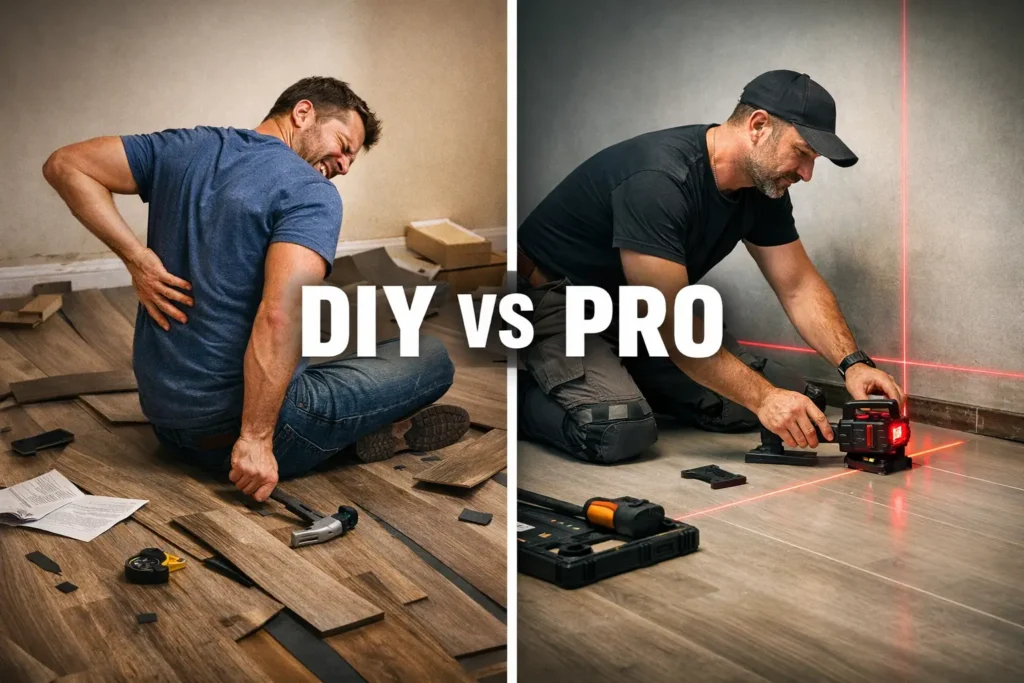
Table of Contents
DIY vs Professional Flooring Installation Cost Comparison in 2026
In 2026, the average cost to install flooring per square foot from the example on this page works out to about $8.00 to $14.00 per square foot for professional installation and about $3.50 to $6.00 per square foot for a DIY project. That gap looks large at first, but it usually shrinks once you include tool rentals, extra material waste, transition pieces, subfloor prep, and the risk of having to redo part of the job.
| Installation Type | 1,000 Sq. Ft. Example | Average Cost Per Sq. Ft. |
|---|---|---|
| Professional Flooring Installation | $8,000 – $14,000 | $8.00 – $14.00 |
| DIY Flooring Project | $3,500 – $6,000 | $3.50 – $6.00 |
For a broader benchmark, compare this page with our average flooring installation cost guide. If you want to separate labor from materials, see our flooring labor cost per sq ft guide.
In 2026, the cost of installing laminate flooring per square foot is split between the product and the expertise. When you hire a professional flooring installer near me, you aren’t just paying for their hands; you are paying for their $5,000 tool kit, their understanding of flooring cost factors, and their insurance.
Average Cost Estimates (1,000 sq. ft. Project)
- 🛠️ Professional installation: $8,000 – $14,000 (includes high-end materials, labor, and warranty).
- 🔨 DIY Project: $3,500 – $6,000 (Includes materials, tool rentals, and inevitable “oops” extra boxes).
Note: The hardwood floor refinishing cost and the luxury vinyl plank installation in the living room are high-value because people realize that specialized rooms need specialized help. If you mess up a DIY kitchen install, the water-damage repair cost will be triple what you saved on labor.
The Hidden DIY Expenses You Haven’t Factored In
Most YouTubers make flooring look easy because they don’t show the five trips to the hardware store. Here are the true DIY flooring installation risks.
If you want to see where surprise charges usually appear, read our hidden flooring costs guide before you assume DIY is automatically the cheaper option.
Unless you own a jamb saw, a miter saw with a carbide blade, and a professional floor pull bar, you’ll spend $300 to $500 on rentals or cheap tools.
Pros work with a 5% waste factor. Beginners usually hit 15% to 20% due to mis-cuts on the expansion gap or around tricky corners.
If your floor isn’t flat, you’ll need self-leveling underlayment. A pro knows exactly how much to use; a DIYer usually buys five bags too many or three bags too few.
The Physical Toll: What Your Knees Won’t Tell You
Most people only look at the money they save on a flooring installation estimate, but they forget that they are the ones doing the heavy lifting.
- Moving a thousand square feet of click-lock planks from your driveway into your living room is a two-ton workout that most people aren’t ready for. You will spend eight hours a day on your knees, and by the second afternoon, your back will start to scream.
- This isn’t just about being tired.
- If you get exhausted, you start making tired mistakes, like forgetting the moisture barrier or rushing the subfloor leveling.
The knee pads you buy at the hardware store for $15 are a joke. Professional installers spend $100 on medical-grade gel pads because they know that cheap ones slip and cut off your circulation. According to OSHA ergonomics guidelines, prolonged kneeling causes severe joint stress. If you choose to DIY, buy the best knee pads you can find and a high-quality pull bar for the edges. You’ll still be sore, but you might avoid a trip to the doctor.
Technical Challenges: Where Most DIYers Fail
It’s easy to lay planks in the middle of a room. It is the edges that separate a pro from an amateur.
The First Row Nightmare
If your first row of click-lock planks isn’t perfectly straight, the entire house will be crooked by the time you reach the other side. A pro uses lasers; a DIYer usually uses a prayer.
Door Jambs and Transitions
- Undercutting: You must cut the bottom of your door frames so the floor slides under them. If you just cut the floor around the frame and fill it with caulk, it looks like a cheap rental property.
- Thresholds: In 2026, matching threshold transitions cost $60-$100 each. If you break one during a DIY install, your savings for the day are gone.
The Warranty Trap: Why DIY Can Be Risky
This is the biggest hidden catch in 2026.
Most high-end flooring brands require a moisture log and proof of subfloor leveling to honor a warranty. If your floor peels or shows signs of developing gaps within 6 months due to humidity, and you don’t have a professional flooring installation estimate or a moisture meter reading from the day of install, they will reject your claim.
Real-world friction: When a pro makes a mistake, they come back and fix it for free. When you make a mistake, you have to buy the material all over again.
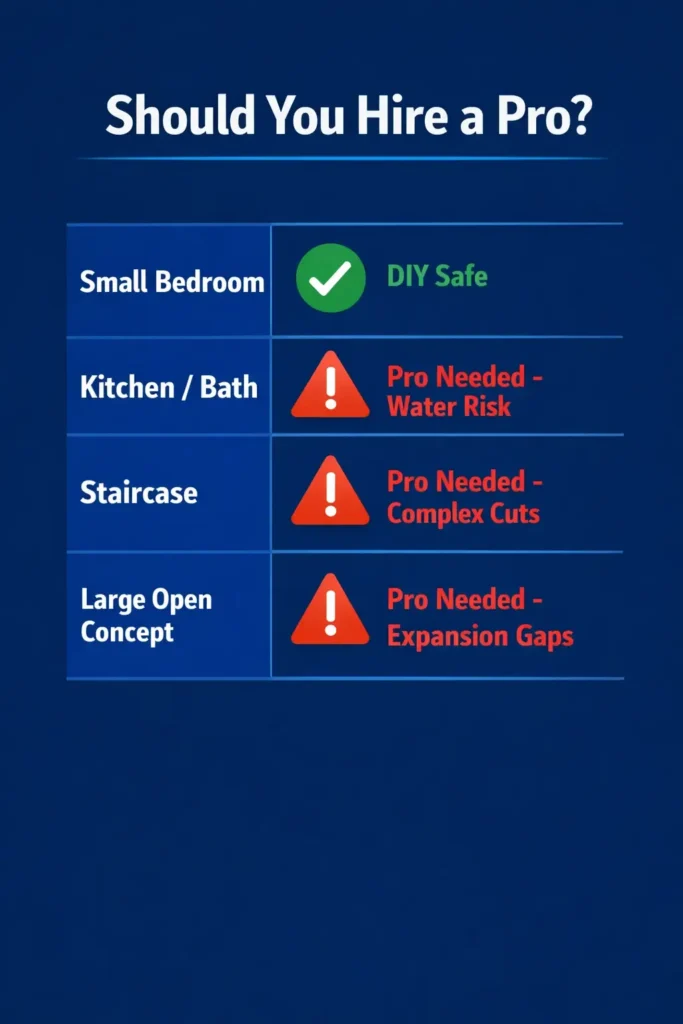
Checklist: Should You Hire a Pro?
| Scenario | Recommendation | Why? |
|---|---|---|
| Small Square Room | DIY | Low risk, minimal cuts. |
| Kitchen or Bathroom | Professional | High moisture risk; need a perfect seal. |
| Staircases | Professional | Stairs are the hardest task in flooring. |
| Open Concept (Large) | Professional | Requires massive expansion gaps and laser-straight lines. |
FAQs
What is the average cost to install flooring per square foot in 2026?
Using the 1,000 square foot example in this guide, professional flooring installation works out to about $8.00 to $14.00 per square foot. A DIY flooring project can come in around $3.50 to $6.00 per square foot, but that lower number usually does not include the full cost of wasted planks, tool rentals, transition pieces, or fixing mistakes.
What is the average labor cost for laminate per square foot?
In 2026, expect to pay $4.00 to $8.00, depending on your location (the US, UK, and Australia are currently at the higher end).
Can I do the demo myself and let a pro install?
Yes! This is the best middle ground. You can save $1.50 per square foot by ripping out the old carpet and staples yourself. You can estimate this using our Carpet Cost Calculator.
How do I find a reliable quote for laminate flooring?
Always get at least three quotes. If one is 50% cheaper than the others, it’s likely skipping the moisture barrier or subfloor prep.
What is the best value floor for DIY?
Luxury Vinyl Plank (LVP). It is easier to cut than laminate, and it is more forgiving if your subfloor isn’t 100% perfect. Get your material estimate via our LVP Calculator.
Can I install the new floor over my old carpet or tile?
Never put a new floor over carpet. The squish will cause your floating floor joints to break within weeks. You can sometimes go over old tile, but only if you first fill every single grout line with a specialized patch compound.
What happens if I start a DIY job and realize I can’t finish it?
In 2026, most professional flooring installers near me will charge you a “Rescue Fee” to fix a half-finished DIY mess. They often have to rip up what you already did because they can’t put their name or warranty on your work.
Conclusion
If you are doing a single bedroom and have a long weekend, go for the DIY. It’s rewarding and saves you the minimum trip fee. But if you are doing your forever home, get a professional flooring installation estimate. The speed, the quality of the finish, and the peace of mind of a 25-year warranty are worth the $4,000 tax.
To verify installer credentials or check independent material safety standards, you can consult the International Certified Flooring Installers Association (CFI). If you are in the UK or Canada, the National Institute of Carpet & Floorlayers (NICF) provides excellent regional standards.