
How to Measure a Room for Flooring: The 2026 Zero-Waste Guide
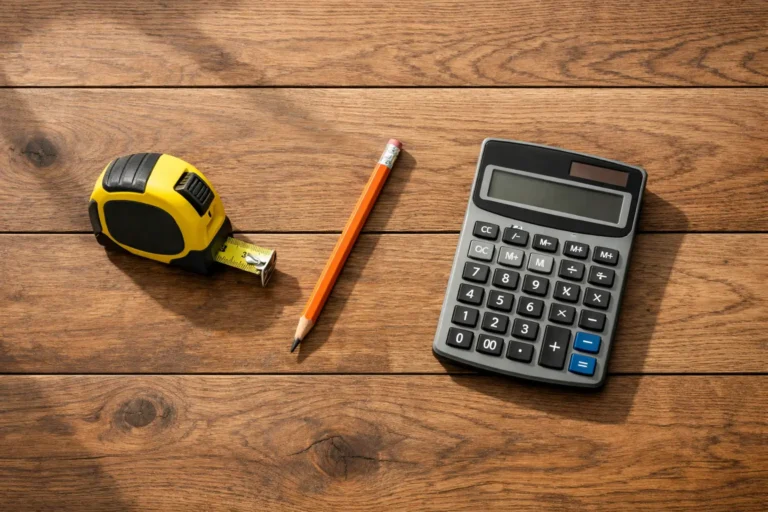
The tape measure is the most underestimated tool in your house. If you get the math wrong by even an inch on a large order, you can lose hundreds of dollars in shipping fees and weeks of your time. Most people walk into a showroom with a rough idea of their room size and end up with a garage full of useless scraps or, worse, a floor that stops three feet short of the wall.
In 2026, many homes in the USA, UK, Canada, and Australia may differ from their original plans due to settling or slight framing shifts. This guide is here to protect your wallet and your sanity. We are going to find your floor’s “In-The-Door” number so you can order with total confidence using our Cost Factors Guide.
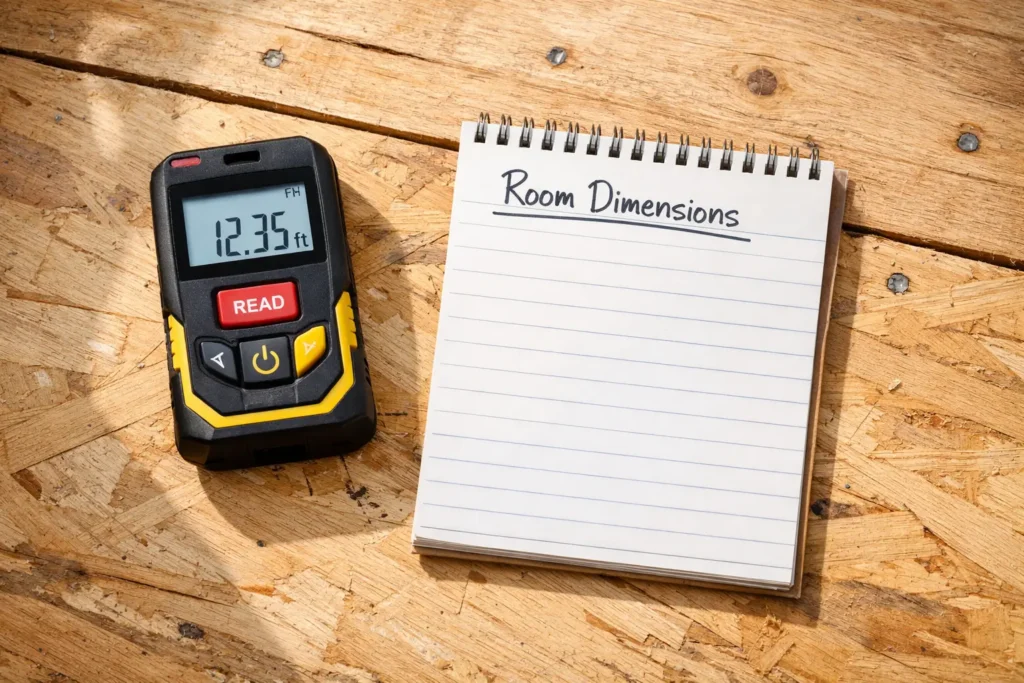
Table of Contents
Which Tool Should You Use?
In 2026, the choice between analog and digital can be the difference between a 10-minute job and an hour of frustration.
Note: Buy a laser measure if you are working alone. Keep a white sticky note to use as a target for the laser beam if it won’t settle.
Why Blueprints Often Fail You
Blueprints are often estimates, not installation realities. A homeowner in Manchester, UK, recently ordered 85 square meters of engineered oak based on her architectural drawings. When the floor arrived, it was 4 meters short.
The reason? The architect measured wall-to-wall before the drywall and skirting boards were installed. Those small skirting boards on every wall can add up to a significant deficit over a whole house.
The Divide and Conquer Method
Do not view your room as a single shape. Unless you live in a perfect square, your home is likely a collection of rectangles joined together. To get an accurate square footage count, you must break the space down into smaller sections.
1. Find the Main Rectangle
- Start with the largest open area.
- Measure from the baseboard of one wall to the baseboard of the opposite wall.
- Do not measure from the drywall; measure from the wood trim.
2. Account for L-Shapes & Alcoves
- If you have an L-shaped room, treat it as two separate boxes.
- Measure Box A, then measure Box B. Add them together at the end.
- If you try to do complex math in your head, it is easy to miss a corner.
How to Calculate Area for Your Region
The math changes depending on where you live, but the logic is the same. Whether you are using our Hardwood Calculator or buying tile, measurement units matter.
🇺🇸 USA and Canada (Square Feet)
Measure in feet and inches. To make the math easy, convert inches into decimals:
- 📏 6 inches = 0.5 ft
- 📏 3 inches = 0.25 ft
- 📏 9 inches = 0.75 ft
Example: If your room is 12 feet, 6 inches long and 10 feet wide, your math is:
12.5 x 10 = 125 square feet.
🇬🇧 UK and Australia (Square Meters)
Measure in meters and centimeters.
Example: If your room is 4.2 meters long and 3.5 meters wide, your math is:
4.2 x 3.5 = 14.7 square meters.
Critical Installation Gaps
Most measurement errors happen at the edges, not in the center. To avoid project delays, account for these common technical friction points:
The Closet and Doorway Rule
Never assume a closet is included in your main room math. A standard closet commonly adds 10 to 15 square feet (1.4 m²). Also, measure into the center of the doorway where the Transition Strip sits; stopping at the wall often results in an ugly 2-inch gap. Check our Carpet Calculator for closet specifics.
The Sliver Cut Nightmare
If you start with a full-width plank, you may end up with a tiny gap at the far wall. These slivers can be too thin to lock properly and may pop out over time. The Fix: If your room width leaves a remainder under 3 inches, cut your first row in half to balance the room.
The Subfloor Flatness Test
LVP and laminate joints are made of thin plastic. If your subfloor has a dip larger than 3/16 of an inch (5mm) over 10 feet, those joints are at risk of snapping. Use a 10-foot straight edge to find these gaps before you use our LVP Calculator.
The Math of Waste and Cartons
Buying the exact square footage of your room is a recipe for failure. According to the EPA guidelines on construction waste, planning for efficiency reduces environmental impact, but you still need an insurance policy for cuts.
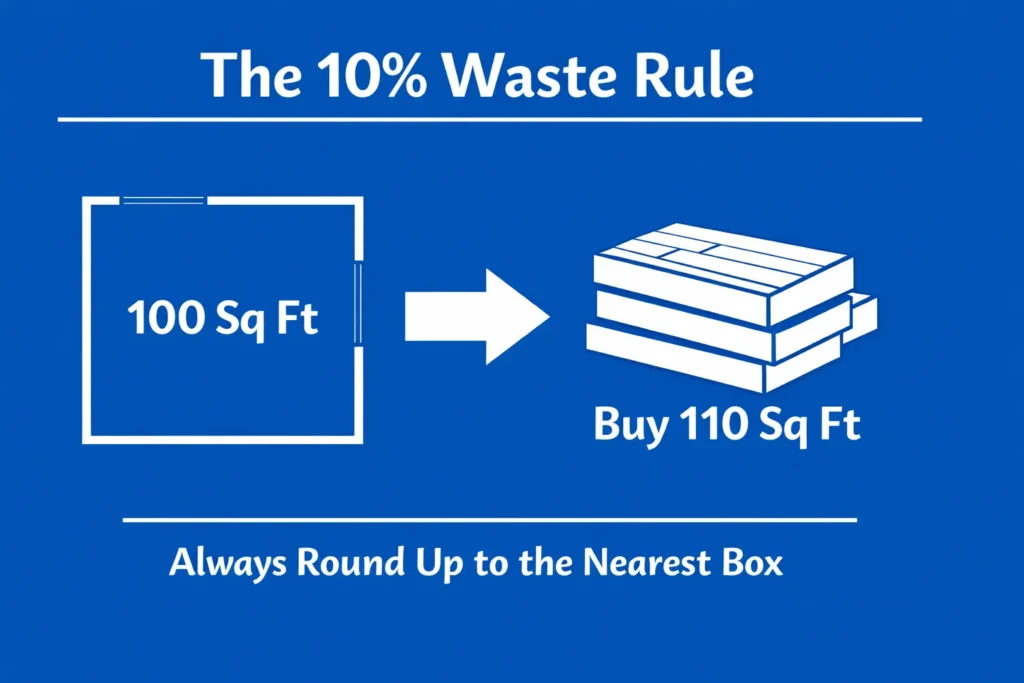
- ✂️ The 10% Waste Factor: For standard rectangular rooms, add 10% to your total area to cover unusable off-cuts.
- 📐 The Pattern Tax: Herringbone or Chevron layouts create more waste at the walls. Increase your waste factor to 15% or 20%.
- 📦 The Box Rounding Rule: Retailers sell in full cartons. If your total, including waste, is 156 sq ft and boxes cover 20.1 sq ft, you must buy 8 boxes. Never round down.
Global Installation Pro-Tips
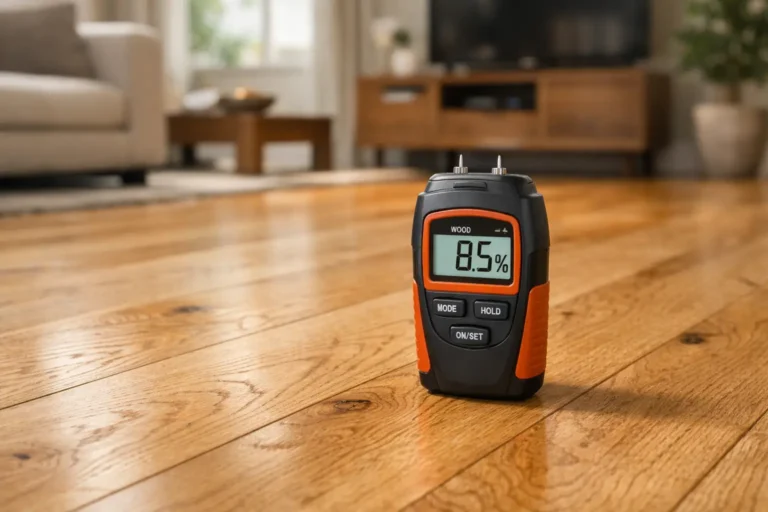
- USA & Canada: Dry winters can cause wood to shrink. Leave a 1/4 inch expansion gap and allow a 72-hour acclimation period inside your home before installation.
- UK & Australia: Concrete slabs are porous. It is generally recommended to use a Moisture Vapor Barrier under LVP or Laminate to prevent odors or mold.
- The Dye-Lot Variable: Product batches can vary in shade. Buy one extra attic stock box now to ensure a perfect match for future repairs.
- Self-Leveling Underlayment (SLU): If your floor fails the flatness test, budget for SLU compound. It is a necessary expense to protect click-lock joints. You can estimate this using our Tile Calculator (Pro Mode).
Measuring Stairs: The High-Cost Zone
Stairs are frequently the most expensive part of a project. You cannot simply measure the length of the staircase.
- Measure the Tread (where you step) and the Riser (the vertical part) separately. Count every step twice.
- LVP stairs require a specialty Stair Nose piece for every step. In 2026, these can often cost $50 to $80 each.
- Treat flat landings as separate small rooms. Do not assume they use the same transition logic as the steps.
FAQs
How do I measure an irregular room with a bay window?
Think of the bay window as a separate trapezoid. Measure the width at the front and the back, average them, and multiply by the depth. Add that result to your main rectangle calculation.
Do I need to remove the furniture to measure?
No, but it helps. If you have heavy furniture, measure to the side of it and then use a best guess for the depth. Note that heavy pieces can sometimes hide floor vents or floor damage.
Should I measure the kitchen under the appliances?
If you are using a floating floor (LVP/Laminate), it is usually best not to install it under heavy fixed appliances like a stove. The weight can pin the floor down, preventing it from expanding naturally. Measure up to the toe-kick of the cabinets instead.
Conclusion
Measurement isn’t just about math; it is about protecting yourself from hidden costs. If you follow these steps, you will have exactly what you need to finish the job.
- Are closets and alcoves included?
- Did you measure into the center of the doorways?
- Did you add the 10% waste factor?
- Did you round UP to the nearest full box?
- Did you check the subfloor for flatness?
Don’t forget the Attic Stock.
Keep one full box of flooring in your garage or attic. Ten years from now, when you have a minor repair or a deep scratch, you will be glad you made that small investment today.

One Comment