
Cheap vs. Expensive Flooring: Is the $10 Plank Worth It?
You walk into a local warehouse and find a wood-look plank for $1.89 per square foot, while the boutique showroom down the street is asking $12.50 for something that looks, at a glance, nearly identical.
Choosing cheap flooring is often like buying a cheap pair of shoes: they look great for a month, but once the soles wear out or the seams pop, you’re back at the store spending more money. This guide will pull back the curtain on the Diminishing Returns of flooring so you can find the perfect Sweet Spot where quality meets a fair price.
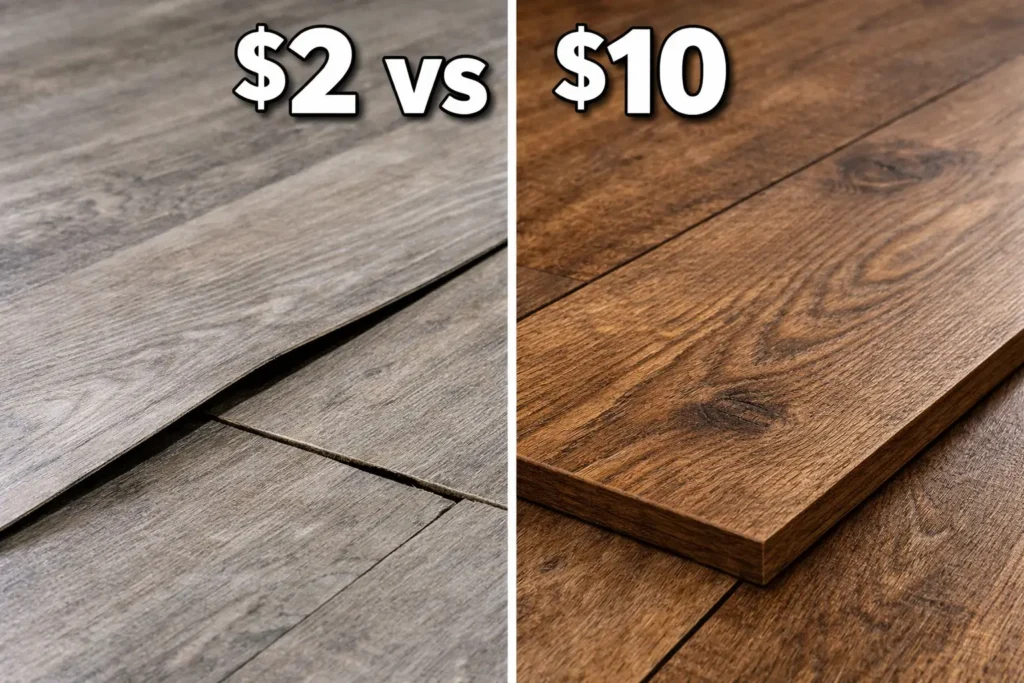
Table of Contents
Visual Fidelity: The Matrix vs. The Forest
The most immediate difference between a $2 plank and a $10 plank is how it handles Pattern Repeat. Because modern synthetic floors like LVP and Laminate are essentially high-resolution photographs printed onto plastic or wood-fiber cores, the variety of those photos determines how realistic the floor looks.
The Budget Tier ($1.50-$3.00): The Matrix Effect
Manufacturers in this tier save money by using a minimal number of unique board designs. Often, there are only 5 to 8 unique planks in an entire shipment.
The Experience: When you install this in a 300-square-foot living room, it creates a “Matrix effect,” a digital grid that screams fake wood.
The Luxury Tier ($8.00-$12.00): The Infinite Grain
Premium 2026 brands often provide 20 to 50 unique planks before a repeat. Some high-end lines even use “Infinite” technology, which randomizes the print.
The Experience: It provides an organic feel that can fool even a professional contractor.
Core Density: The Skeleton of Your Floor
What is inside your plank matters more than what’s on top. In 2026, the industry standard has shifted toward SPC (Stone Plastic Composite), but the stone’s density varies widely by price point.
| Feature | Budget Tiers ($2–$4) | Premium Tiers ($7–$12) |
|---|---|---|
| Material Core | WPC (Wood-Plastic) or low-density Vinyl | High-Density SPC (Crushed Limestone) |
| Plank Thickness | 3.5mm-4.5mm | 8mm-12mm |
| Acoustics | High Hollow Clack | Deep, Solid Thud |
| Indentation | Heavy sofas will leave permanent dents | Extremely dent-resistant |
Cheap, thin planks lack the mass to absorb sound. When you walk on them in heels, it produces a clicking sound. Expensive planks absorb vibration, making the floor feel like a permanent part of the house foundation rather than a plastic cover.
The Wear Layer: Your Floor’s Body Armor
The Wear Layer is the clear, protective coating applied to the print. This is the only thing standing between your dog’s claws and the pretty wood pattern.
- 📉 Bargain Flooring (6 mil-12 mil): This is a thin skin. It is fine for a rarely used guest bedroom, but in a kitchen or a home with pets, it will look foggy or scratched within 24 months.
- 📈 Premium Flooring (20mil-30 mil): Commercial-grade protection. In 2026, high-end brands infuse this with Ceramic Bead or Aluminum Oxide technology. This makes the surface nearly as hard as a diamond.
Tactile Experience: EIR and The Feel Test
If you close your eyes and run your hand over a $2 plank, it feels like smooth plastic. If you do the same to an $8 plank, you might swear it was real oak. This is due to EIR (Embossed in Register) technology.
EIR doesn’t just look better, it provides traction. Smooth, cheap floors become dangerously slippery when wet. Textured, expensive floors offer the grip that seniors, dogs, and young children need to stay safe.
Hydrothermal Expansion
This is where cheap labor and cheap materials combine to ruin a renovation. Every floor expands and contracts when the temperature or humidity changes. For standards on moisture control, see the NWFA Technical Guidelines.
Cheap floors have poor Dimensional Stability. On a hot summer day, a budget vinyl floor can expand so much that it hits the wall, causing the middle of the floor to bubble. Premium floors, especially high-density SPC, are thermally stable.
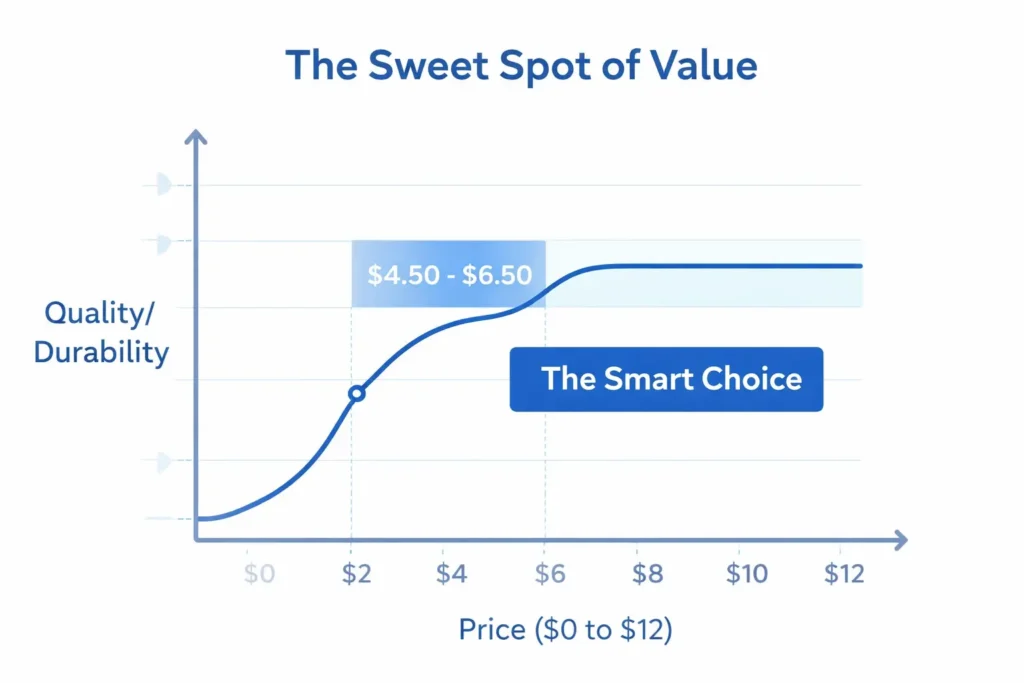
The Sweet Spot: Maximizing Your ROI
There is a specific point at which spending more money no longer yields a better floor; it produces a designer label.
For 90% of homeowners, the Sweet Spot is $4.50 to $6.50 per square foot. According to 2026 market data from Angi, this tier gets you:
- ✅ A 20 mil wear layer (Pet and kid-proof).
- ✅ A high-density SPC stone core.
- ✅ Integrated Underlayment (Saving you $1.00/sq ft).
- ✅ EIR Texture for a realistic look and safety.
Once you go above $9.00 per square foot, you are usually paying for Luxury Logistics like extra-wide planks or specialized patterns like Herringbone.
The Cost of a Do-Over
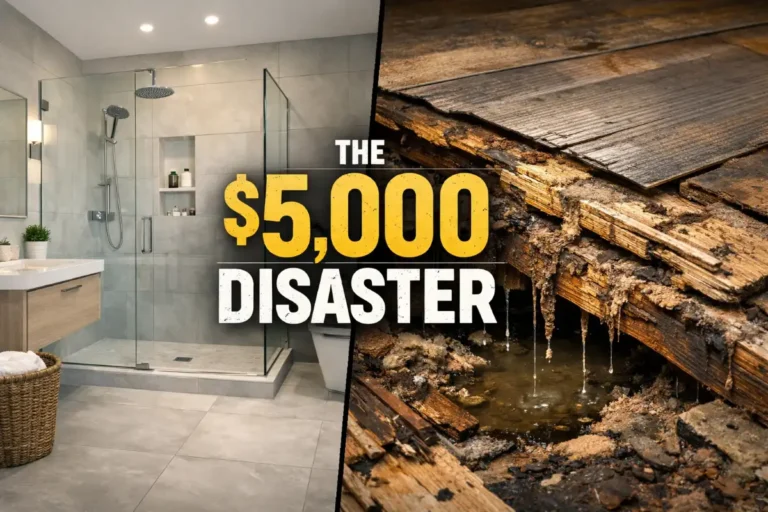
The highest hidden cost of cheap flooring is the Amortization of Failure. If you buy a floor for $2.50/sq ft and it fails in 4 years, you aren’t just out the $2.50. You have to pay for:
- The removal and disposal of the old floor (Check Removal Costs).
- The purchase of the new floor.
- The labor to install the new floor, which has likely gone up 20% by then.
A $6.00 floor that lasts 20 years is significantly cheaper than a $2.50 floor that you have to replace three times.
FAQs
Does higher-end flooring increase a home’s resale value?
In 2026, homebuyers are seeking solid-surface flooring. Replacing carpet with a $5.00 LVP gives a massive ROI. However, moving from a $5.00 LVP to an $11.00 LVP rarely increases the home’s appraisal value.
Why is my expensive floor still scratching?
Even a $20-per-foot floor can scratch if you don’t use felt pads. If your priority is Scratch Resistance, a high-end Laminate is actually superior to expensive Vinyl.
Is thicker always better for durability?
Not always. A 5mm SPC (Stone Core) is more stable and dent-resistant than an 8mm WPC (Wood-Plastic Core). In 2026, check the Core Material before reviewing the total thickness.
Is it okay to use cheap flooring in closets?
Yes. Use the premium planks in your Living Room and Kitchen where guests see them. Use a color-matched, budget-friendly version in Closets and Spare Bedrooms to save your budget.
Conclusion
Don’t buy the $2.00 plank for a high-traffic family home. It is a disposable product that will show its age within 36 months. However, you don’t need the $12.00 designer plank unless you require Infinite patterns.
The Smart Money choice for 2026 is the $5.00 to $6.00 range.
One Comment